
4K vs 6K Drone Camera: Does It Really Matter?
Bywpdev
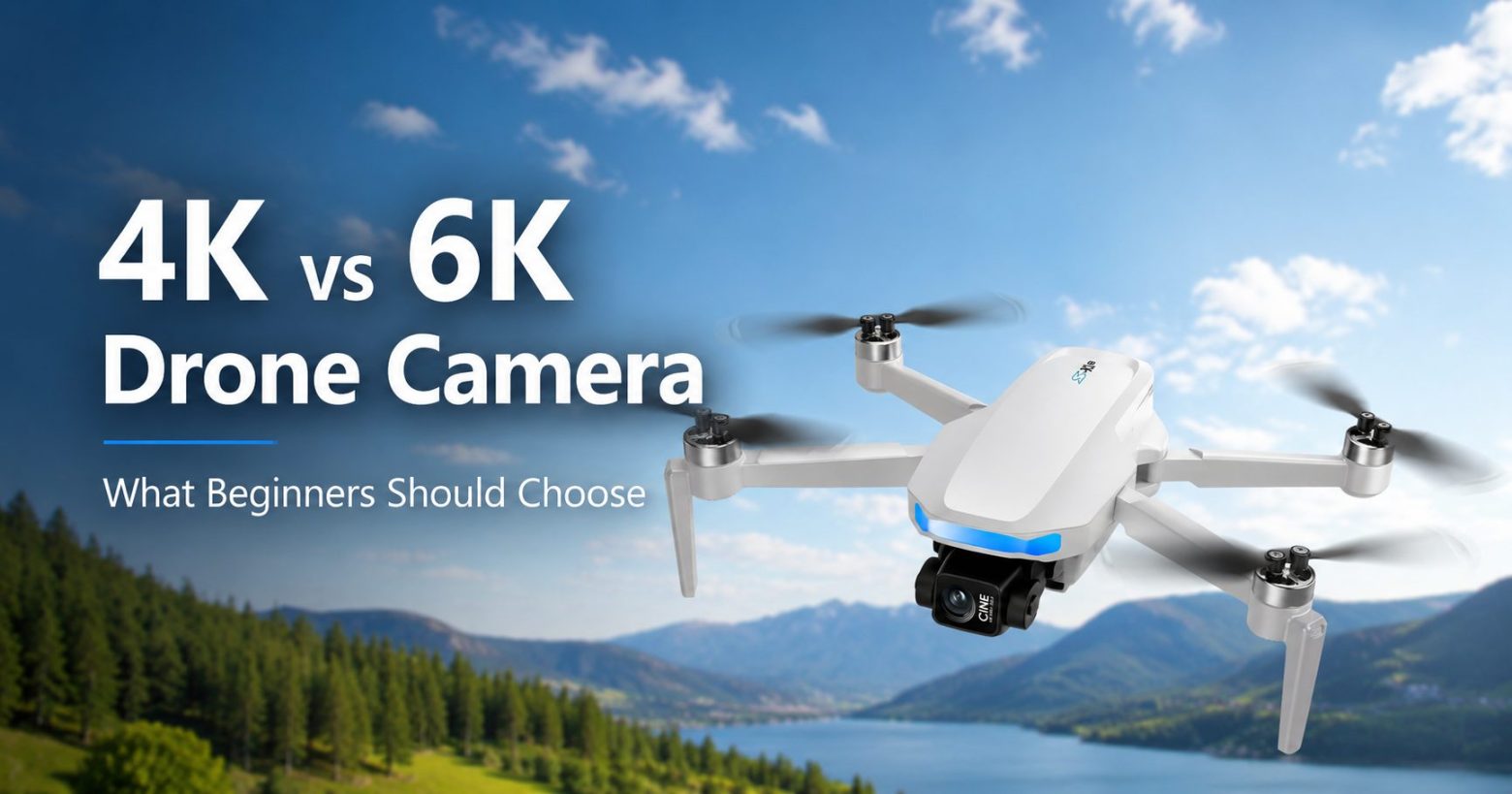
A 6K drone camera records more pixels than a 4K drone camera, which can help if you crop heavily, reframe shots, or work on large-display projects. But for most beginners, 4K is the smarter choice. It looks sharp on phones, laptops, TVs, and social platforms, creates smaller files, edits more easily, and keeps the drone budget focused on the features that matter more: stabilization, smooth control, good lighting, and reliable outdoor flying. In practice, a stable 4K drone is usually a better beginner choice than a harder-to-edit 6K drone with weak stabilization.
When beginners compare camera drones, one number usually grabs attention first: resolution. Product pages often highlight 4K, 6K, or even larger numbers, and it is easy to assume the bigger number must be the better drone. More pixels sound like better footage.
That is not always how drone video works. Camera resolution matters, but it is only one part of the final image. A drone with strong stabilization, smooth movement, and a reliable camera platform can produce better-looking 4K footage than a higher-resolution drone that is shaky, difficult to control, or frustrating to edit.
This guide explains what 4K and 6K actually mean, when 6K is useful, what hidden costs come with higher-resolution footage, and why 4K is usually the right choice for a beginner camera drone.
Quick Answer: Is 6K Better Than 4K on a Drone?
6K is better if you need extra pixels for cropping, digital zoom, professional editing, or very large displays. For most beginners, 4K is better in real use because it already looks excellent, is easier to edit, uses less storage, and costs less. Once you reach 4K, stabilization, frame rate, lighting, and smooth flight movement usually affect video quality more than extra resolution.
| Beginner Need | Better Choice | Why |
|---|---|---|
| Easy editing on a normal laptop | 4K | Smaller files and smoother playback |
| Social media, YouTube, travel clips | 4K | Sharp enough for most screens and platforms |
| Cropping and reframing in editing | 6K | Extra pixels give more room to crop |
| Large-screen or professional output | 6K | Higher detail can matter in specific workflows |
| First camera drone purchase | 4K with stabilization | More practical and easier to use |
What Do 4K and 6K Actually Mean?
Resolution describes how many pixels make up each video frame. More pixels can capture more detail, but only if the rest of the camera system and flight footage support that detail.
- 4K video is usually around 3840 pixels wide, depending on the exact format. It is the current practical standard for sharp consumer video.
- 6K video is roughly 6000 pixels wide, depending on the camera format. It records more image data and gives editors more room to crop or reframe.
The important point is this: most people do not watch drone footage on a true 6K display. Phones, laptops, tablets, TVs, and social platforms usually show video at 4K or lower. That means 6K footage is often scaled down before the viewer ever sees it.
So 6K is not useless, but its main advantage is not that every viewer will see a dramatically sharper image. Its main advantage is editing flexibility.
What the Resolution Number Does Not Tell You
Resolution is easy to compare because it is a single number. But drone video quality is not decided by resolution alone. A spec sheet may say 4K or 6K, but that does not automatically tell you how good the footage will look.
| Factor | Why It Matters | Beginner Impact |
|---|---|---|
| Stabilization | Controls shake, vibration, and movement | Often more important than resolution |
| Frame rate | Affects smoothness and motion quality | Useful for outdoor movement and action shots |
| Lens angle and control | Changes framing and shooting flexibility | Helps beginners compose shots more easily |
| Signal and live view | Helps you frame while flying | Poor live view makes good footage harder |
| Pilot movement | Smooth flying creates smoother footage | A steady beginner pilot beats a shaky high-resolution shot |
| Lighting | Controls clarity, contrast, and color | Good light improves any camera |
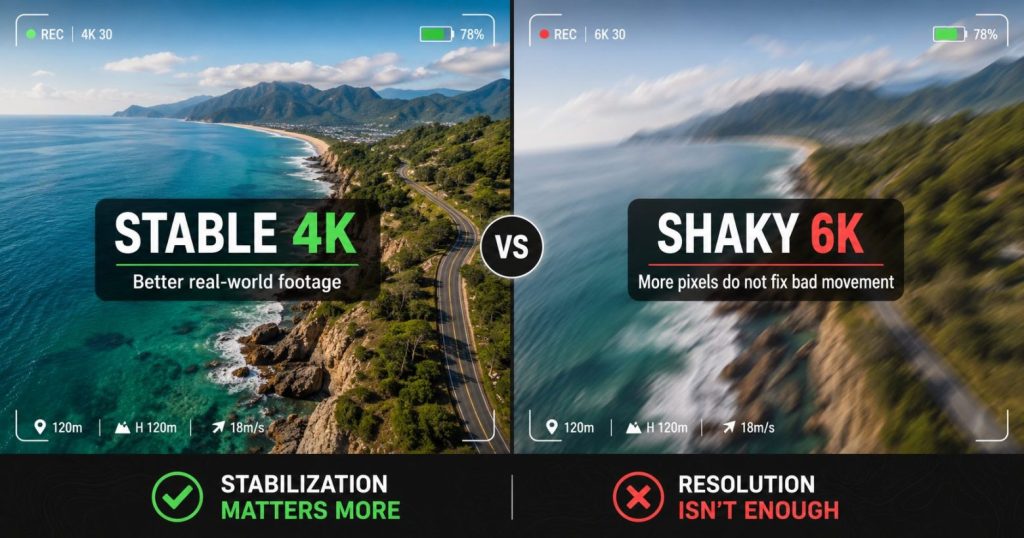
This is why a stable 4K drone can be a better camera tool than a 6K drone that is difficult to fly smoothly. A sharper shaky video is still a shaky video.
Where 6K Drone Video Genuinely Helps
6K is not just a marketing number. It has real value when the pilot or editor has a workflow that uses the extra image data.
- Cropping and reframing: You can crop into a 6K shot and still export a clean 4K frame.
- Digital zoom in editing: Extra pixels let you zoom in farther before the image starts to look soft.
- Large-screen output: Very large displays or professional projects can benefit from extra captured detail.
- Professional post-production: Editors who know they will reframe, stabilize, or deliver multiple versions may want more pixels.
- Archiving footage: Some creators prefer higher-resolution source footage for future editing flexibility.
These advantages matter most when you already know how you will use them. If you mainly want travel clips, family footage, neighborhood flights, social media videos, or YouTube uploads, 6K may add cost and complexity without changing the result most viewers see.
What 6K Costs You in Real Use
The tradeoff with 6K is not only price. Higher-resolution footage usually creates more work after the flight.
- Larger files: 6K footage usually takes more storage than 4K, though the exact difference depends on bitrate, codec, frame rate, and compression.
- More demanding editing: 6K playback and editing can lag on average laptops, especially with longer clips.
- More storage planning: Memory cards, external drives, and backups become more important.
- Higher drone cost: True 6K recording is usually found on higher-end models, not entry-level beginner drones.
- Less practical benefit for casual sharing: Many platforms compress uploads, and many viewers watch on small screens.
For beginners, these costs arrive immediately. The benefits of 6K usually arrive only if you edit heavily or have a specific professional use case.
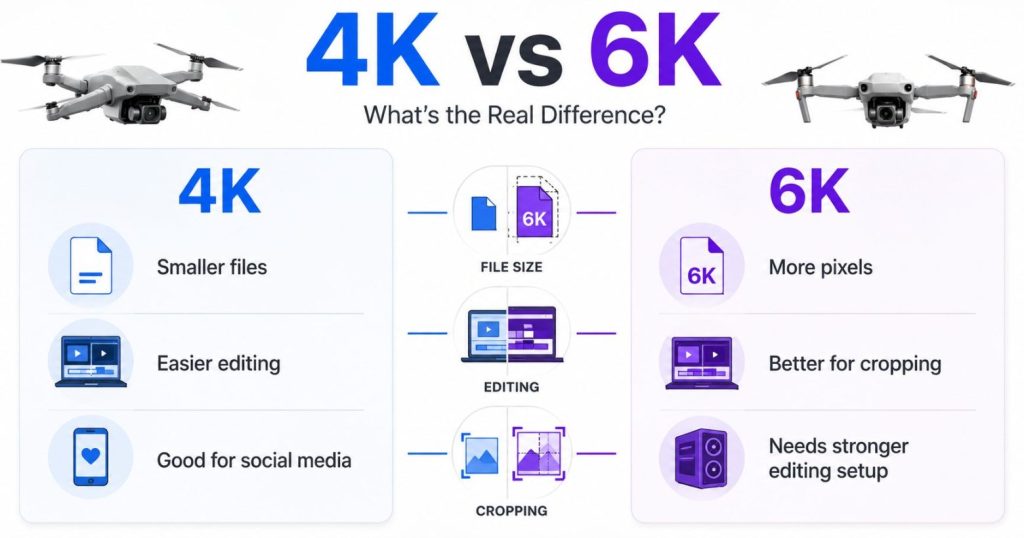
4K vs 6K Drone Camera: Side-by-Side Comparison
| Factor | 4K Drone Camera | 6K Drone Camera |
|---|---|---|
| Detail | Sharp enough for most users | More detail, especially useful for cropping |
| Editing | Easier on normal computers | More demanding |
| Storage | More manageable | Larger files and more backup space |
| Social media | Very practical | Often downscaled or compressed |
| Beginner learning | Better fit for most pilots | Usually unnecessary at first |
| Professional flexibility | Good, but less crop room | Better for reframing and large projects |
| Cost | More beginner-friendly | Usually higher |
| Best use | Travel, YouTube, social media, casual aerial video | Professional editing, cropping, large display output |
What Beginners Should Prioritize Instead of 6K
For a first camera drone, the smarter question is not only “Is it 4K or 6K?” The better question is: “Can I actually capture steady, usable footage with it?”
- Choose stabilization first: EIS or a 3-axis gimbal can improve real footage more than a higher resolution number.
- Look for smooth control: Jerky flight movement can ruin footage even when the camera is sharp.
- Consider frame rate: Higher frame rates, such as 50 fps or 60 fps where available, can make motion look smoother.
- Check live-view comfort: A screen remote or reliable app view makes framing easier while flying.
- Think about editing: If you edit on a normal laptop, practical 4K files are easier to manage than heavier 6K clips.
Based on the provided RCDronego model information, the S-X1 is a good example of why resolution is not the only camera feature to compare. It focuses on 4K video with a 3-axis gimbal and screen remote, which can be more useful for smooth beginner footage than chasing a bigger resolution number alone.
When Should a Beginner Choose 4K?
Most beginners should choose a 4K drone camera if they want a practical balance of image quality, price, file size, and ease of use. If you want to see how camera quality factors into picking your first drone overall, our guide to the best camera drones for beginners walks through it.
- You are learning to fly and want fewer technical problems.
- You plan to share videos on YouTube, TikTok, Instagram, Facebook, or family chats.
- You edit on a normal laptop or phone.
- You do not want huge files filling up memory cards and drives.
- You care more about smooth footage than maximum pixel count.
- You want to keep more budget for GPS, return-to-home, battery packs, screen remote, or stabilization.
For this type of user, 4K is not a compromise. It is the practical standard.
When Should You Consider 6K?
6K makes more sense when the buyer already has a clear editing or production reason for it.
- You frequently crop footage and still want to export in 4K.
- You edit on a powerful computer that can handle large files smoothly.
- You create paid video work or large-display projects.
- You understand the storage, backup, and workflow requirements.
- You already know that 4K limits your editing flexibility.
If none of these apply, 6K may be more of a spec-sheet upgrade than a real improvement to your beginner flying experience.
Common Beginner Mistakes With Drone Camera Resolution
- Buying the biggest number: A higher resolution does not automatically mean better beginner footage.
- Ignoring stabilization: Shaky footage looks bad in 4K, 6K, or any resolution.
- Forgetting editing requirements: Heavy files can make the editing process frustrating.
- Assuming viewers will see 6K: Most viewers watch on phones, laptops, or platforms that compress video.
- Overpaying before learning your style: Beginners often do not know yet whether they need cropping flexibility or professional output.
A better buying approach is to choose a drone that you will actually use often, edit comfortably, and fly smoothly.
Frequently Asked Questions
6K records more pixels than 4K, so it can capture more detail and give editors more room to crop or reframe footage. But for most beginners, 4K is the better practical choice because it already looks sharp on common screens, creates smaller files, edits more easily, and usually costs less. 6K is most useful when you have a specific editing or professional output reason for it.
Most beginners do not need a 6K drone camera. A 4K drone camera is usually enough for travel videos, family footage, YouTube, social media, and learning aerial filming. Beginners should usually prioritize stabilization, smooth control, GPS support, return-to-home, and comfortable editing over extra pixels.
6K footage contains more image data than 4K, so it usually requires more processing power, more storage space, and a stronger editing workflow. The exact file size depends on bitrate, codec, frame rate, and compression, but beginners using an average laptop may find 6K editing slower and less convenient than 4K editing.
Stabilization usually matters more than resolution once you reach 4K. A steady 4K shot often looks better than a shaky 6K shot. Frame rate, lighting, smooth flight movement, lens control, and good composition also affect the final video more than extra pixels alone.
Yes. 4K is enough for YouTube, TikTok, Instagram, travel videos, and most social media use. Many viewers watch on phones or laptops, and platforms may compress uploaded video. For most creators, stable 4K footage is more useful than larger 6K files that are harder to edit and share.
If smooth video matters more than chasing a bigger resolution number, look at a model with strong stabilization and stable outdoor flight. Based on the provided RCDronego model information, the S-X1 pairs 4K video with a 3-axis gimbal and screen remote, making it a more practical choice for beginners who want smoother aerial footage.
The Bottom Line
For most beginners, 4K is the right drone camera choice. It is sharp enough for the screens and platforms people actually use, easier to edit, easier to store, and usually more budget-friendly. 6K has real value for cropping, reframing, and professional workflows, but those benefits matter most after you already know how you will use the footage. If you are buying your first camera drone, prioritize stable 4K footage, smooth control, good lighting, and reliable outdoor flying before chasing a bigger resolution number.