
Best GPS Drone Under $500: A Beginner’s Buying Guide
Bywpdev
⚡ Quick Answer
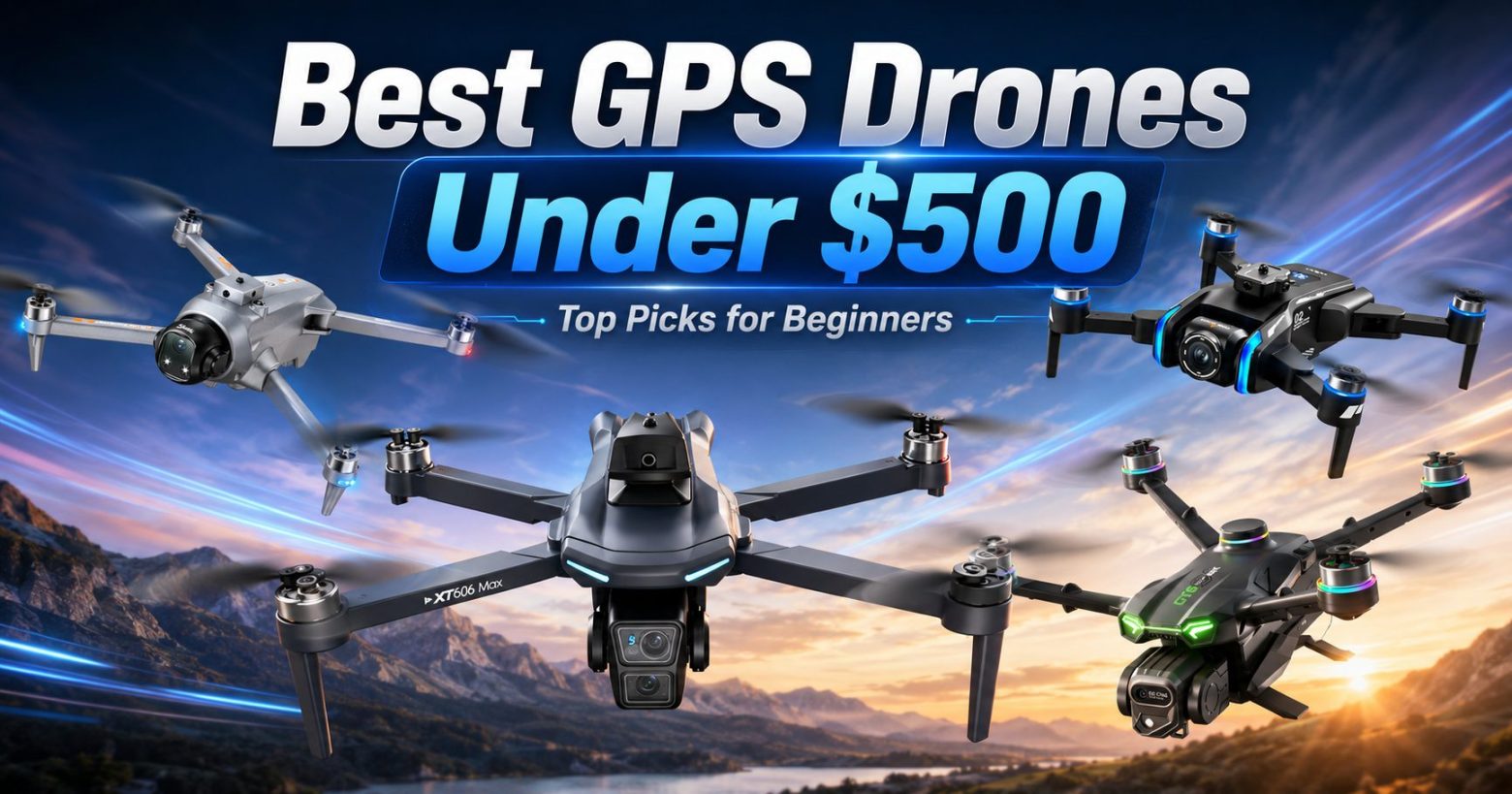
Under $500, you can get a fully featured beginner GPS drone with GPS positioning, return-to-home, a 4K camera, a brushless motor, and a built-in screen remote. For the lowest entry price, the XT606 starts around $336. For the most screen and dual positioning, the XT808 sits in the mid-$400s. For a balance of long range and a big screen, the GT6 offers strong value. All of these deliver the core outdoor-flying features beginners actually need — the differences come down to screen size, range, and stabilization, not whether you get the essentials. In short: pick the XT606 for the lowest price, the GT6 for range and a big screen, or the XT808 for the easiest setup.
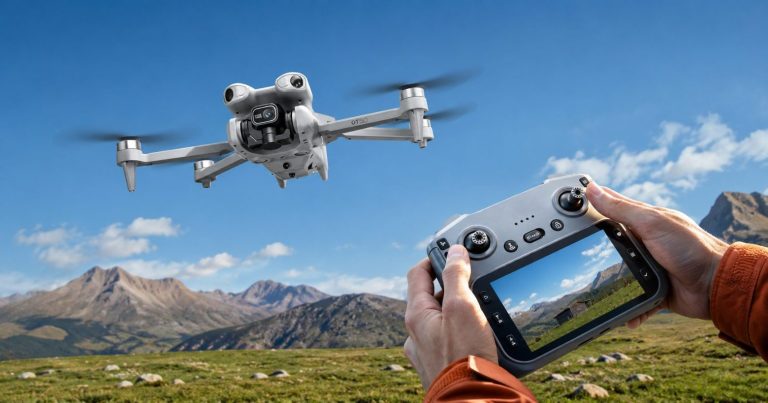
There is a sweet spot in the drone market that most beginners don’t know exists. Below it, you get toys — drones that drift, lose signal, and won’t come back. Above it, you get professional gear priced like a used car. But right around the $500 mark, something good happens: you can get real GPS positioning, return-to-home, a 4K camera, a brushless motor, and a screen remote — the genuine features that make outdoor flying enjoyable — without paying flagship prices.
The catch is that “under $500” covers a wide range, and not every drone in that bracket spends your money the same way. This guide breaks down exactly what you should expect from a GPS drone under $500, which models deliver the most for the money, how to think about your budget, and where it makes sense to spend a little more or a little less. The goal is simple: help you get the most drone for your money without overpaying for features you won’t use or underpaying for ones you’ll wish you had.
What $500 Actually Buys You in a GPS Drone
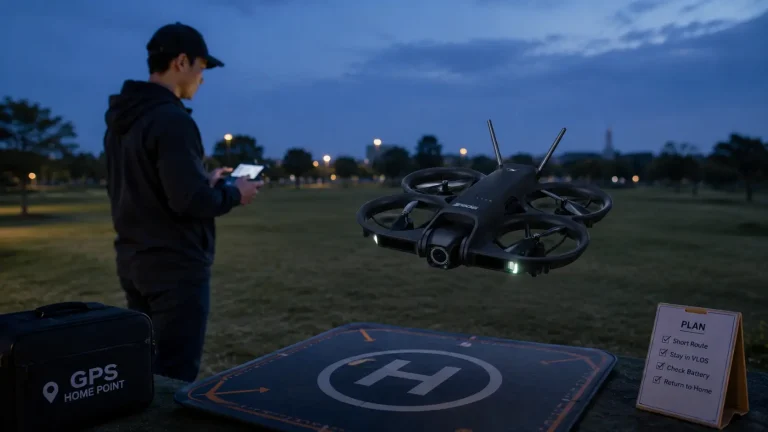
Before comparing models, it helps to reset your expectations — in a good way. A few years ago, the features below were reserved for expensive drones. Today, under $500, you should expect all of them as standard. If a drone in this price range is missing any of these, keep looking.
- GPS positioning: the drone holds its place in the air outdoors and resists drifting in light wind.
- Return-to-home: the safety net that flies the drone back to its takeoff point, so you don’t lose it.
- 4K camera: sharp photo and video resolution is now standard at this price, not a premium add-on.
- Brushless motor: quieter, more powerful, and far longer-lasting than the brushed motors in cheap toys.
- Foldable, sub-250g body: light and compact enough to carry to a park or pack for travel.
- Screen remote or app control: a live view of what the camera sees, often on a built-in screen.
What you generally won’t get under $500 is the very top tier of camera hardware — think large-sensor cameras, obstacle avoidance as standard on every model, or the longest-range professional transmission systems. And that’s fine: for a beginner learning to fly outdoors, the features in the list above are exactly the ones that matter, and the ones you’d miss if they were absent. Paying more mostly buys refinements, not fundamentals.
The Best GPS Drones Under $500, Compared
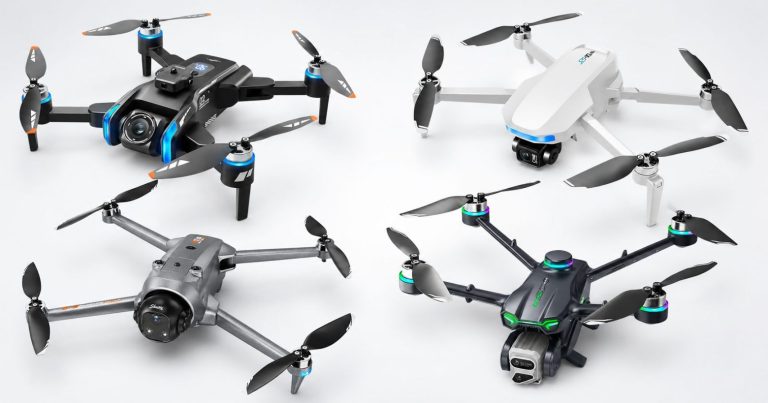
Here are the GPS drones in our lineup that come in under $500, with their real starting prices and key specs, so you can see exactly what each one gives you for the money (a dash means the figure isn’t specified for that model):
| Model | Starting Price | GPS + RTH | Screen | Range / Transmission | Stabilization | Best For |
|---|---|---|---|---|---|---|
| XT606 | ~$336 | Yes | 4.3″ | 500 m / 300 m | — | Lowest-cost entry |
| GT6 | ~$388 | Yes | 5.64″ | 2000 m / 2000 m | EIS | Range + big screen |
| AE20 Max | ~$428 | Yes | Yes | 1000 m / 800 m | 180° lens | Lightweight travel |
| XT808 | ~$448 | Yes | 5.9″ | — | Optical flow + GPS | Easiest beginner setup |
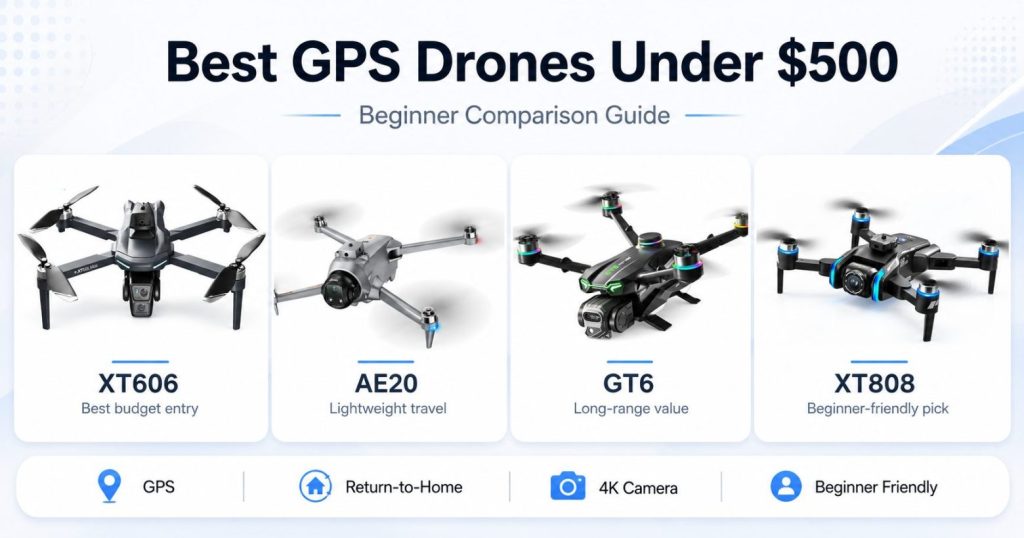
Notice that every one of these includes GPS, return-to-home, a 4K camera, a brushless motor, and a foldable body. The price differences reflect screen size, range, and stabilization — not whether you get the core features. That’s the key insight for shopping under $500: you’re choosing which extras matter to you, not whether you get a “real” GPS drone. You can also see how these fit into the wider picture in our guide to the best GPS drones for beginners.
Breaking It Down by Budget
Around $350: The Value Entry Point
If you want to spend as little as possible while still getting a genuine GPS drone, the XT606 is the entry point at around $336. It doesn’t skip the essentials: GPS with return-to-home, a 4K front camera, a brushless motor, up to 25 minutes of flight time, and a 4.3-inch screen remote in a compact 223 g body. Its range (500 m control, 300 m transmission) is shorter than pricier models, but for a beginner staying within sight in a local park, that is more than enough. This is the drone to buy when your priority is getting into GPS flying at the lowest sensible price.
Around $400: The Range and Screen Upgrade
Step up to around $388 and the GT6 changes what you can do. Its standout feature is range: 2000 m of both control and video transmission, meaning the live feed keeps up with how far it can fly. Add a large 5.64-inch screen remote, a 4K camera with EIS stabilization, a 2100KV brushless motor, and around 25 minutes of flight time, and you get noticeably more capability for a modest jump in price. If you can stretch from the entry level to this bracket, the extra range and bigger screen are the upgrades most beginners feel the most.
Mid-$400s: Travel-Friendly and Beginner-Friendly Options
In the mid-$400s you have two strong choices with different strengths. The AE20 Max (around $428) is the travel pick: a 246 g takeoff weight, a 180° electronically adjustable lens, around 22 minutes of flight time, and a folded size that drops easily into a day bag. The XT808 (around $448) is the easiest to learn on: it pairs GPS with optical-flow positioning for extra stability and has the largest screen in the lineup at 5.9 inches, so the live view is easy to read. Both sit comfortably under $500 while adding meaningful convenience over the entry level.
How to Spend Your Budget Wisely
Getting the most out of a sub-$500 budget isn’t only about which drone you pick — it’s about how you allocate the total you’re willing to spend. A few principles help beginners avoid the most common budgeting mistakes.
- Leave room for a spare battery. This is the single best add-on for a beginner. One 20–25 minute battery disappears fast outdoors, and a two- or three-battery package turns a single short outing into a full afternoon of practice. If choosing between a slightly pricier drone with one battery or a slightly cheaper one with a multi-battery pack, the batteries are often the better value.
- Don’t overspend on range you can’t use. Because you should fly within sight, a 500–2000 m range already exceeds what a beginner will safely use. Paying a premium purely for maximum range is money better spent elsewhere while you’re learning.
- Do spend on a screen remote if setup frustrates you. A built-in screen means no phone, no app, no disconnects — a genuine quality-of-life upgrade that’s worth prioritizing if you value getting airborne quickly.
- Budget a little for accessories. Spare propellers, a carrying case, and extra memory come in handy and are easy to forget in the initial excitement of buying the drone itself.
We fly each model outdoors before recommending it to beginners, and the pattern is consistent: the pilots who enjoy their first month most aren’t the ones who bought the most expensive drone — they’re the ones who bought a stable, capable drone and a spare battery, and spent their time flying instead of charging. The clip below is from one of our outdoor sessions.
Where to Save and Where to Spend
Not every feature deserves the same weight in your decision. Here’s an honest breakdown of what’s worth paying for as a beginner and what you can comfortably skip to stay under budget.
| Feature | Worth Paying For? | Why |
|---|---|---|
| GPS + return-to-home | Always | The core of safe outdoor flying — never skip these |
| Spare battery | Yes | Best value upgrade; more air time per outing |
| Screen remote | Often | Removes phone-setup hassle; big convenience gain |
| Bigger screen | Nice to have | Easier to read, but not essential to fly well |
| Maximum range | Usually skip | You’ll fly within sight anyway while learning |
| 3-axis gimbal | Only if video-focused | Great for smooth footage; adds cost you may not need yet |
The theme is consistent: spend on the features that keep you flying safely and often (positioning, recovery, battery life), and treat the rest as optional upgrades you can prioritize based on what you personally care about.
Is It Worth Spending More Than $500?
Honest answer: not for most beginners, at least not at first. Once you cross above $500, you start paying for refinements — a 3-axis gimbal for smoother video, longer professional-grade transmission, or higher-end camera hardware. Those are real improvements, but they matter most once you’ve developed your skills and know what kind of flying you actually enjoy.
For context, a model like the S-X1 sits just above this bracket at around $538, adding a 3-axis gimbal and a 5000 m transmission system. If smooth cinematic video is your specific goal, that jump can be worth it. But if you’re buying your first GPS drone to learn outdoor flying, a sub-$500 model gives you every fundamental you need, and leaves budget for the battery and accessories that will improve your early experience more than a pricier drone would. You can always upgrade later, once you know exactly what you want.
Frequently Asked Questions
It depends on your priority. For the lowest price, the XT606 starts around $336 with GPS, return-to-home, and a 4K camera. For range and a big screen, the GT6 offers 2000 m range and a 5.64-inch display starting around $388. For the easiest setup, the XT808 adds optical-flow positioning and a 5.9-inch screen in the mid-$400s. All include the core features beginners need, so the best choice comes down to whether you value price, range, or ease of use most.
Yes. Under $500, you can get a fully featured GPS drone with GPS positioning, return-to-home, a 4K camera, a brushless motor, and a built-in screen remote. These are the genuine features that make outdoor flying enjoyable for beginners. What you typically won’t get at this price is top-tier camera hardware or professional-grade range, but those aren’t necessary for learning to fly outdoors.
At this price, you should expect GPS positioning, return-to-home, a 4K camera, a brushless motor, a foldable sub-250g body, and either a screen remote or app control as standard. If a drone in this range is missing any of these core features, it’s worth looking at other options. Paying more than $500 mostly adds refinements like a 3-axis gimbal or longer range, not the fundamentals.
For most beginners, a spare battery is the better value. A single battery gives roughly 20–25 minutes of flight time, which disappears quickly outdoors. A two- or three-battery package turns one short outing into a full session of practice. If you’re choosing between a pricier drone with one battery and a more affordable one with a multi-battery pack, the extra batteries often improve your early experience more than the pricier drone would.
Usually not at first. Above $500, you mainly pay for refinements like a 3-axis gimbal, longer transmission range, or better camera hardware. These matter most once you’ve developed your skills and know what kind of flying you enjoy. A sub-$500 GPS drone gives you every fundamental you need to learn, and you can always upgrade later once you know exactly what you want.
Yes. A 4K camera is now standard on GPS drones under $500, including the XT606, GT6, AE20 Max, and XT808. At this price, 4K resolution is a baseline feature rather than a premium add-on. The differences between models tend to be in stabilization — such as EIS or a 180° adjustable lens — rather than raw resolution.
Quick Decision
- Lowest price: XT606 (~$336) — real GPS flying at the most accessible entry point.
- Best all-round value: GT6 (~$388) — 2000 m range and a big 5.64-inch screen.
- Easiest to learn on: XT808 (~$448) — dual positioning and the largest 5.9-inch screen.
The Bottom Line
Under $500 is the sweet spot for a first GPS drone. It’s where you get all the fundamentals — GPS, return-to-home, 4K, a brushless motor, and a screen remote — without paying for professional features you don’t yet need. Start with the XT606 if price is your priority, step up to the GT6 for range and a big screen, or reach for the XT808 for the easiest, most beginner-friendly setup. Whichever you choose, leave a little budget for a spare battery — it’s the upgrade you’ll appreciate most.