
Best Long-Range GPS Drones for Beginners: S-X1 vs GT6
Bywpdev
For buyers comparing the best long-range GPS drones for beginners, the GT6 is the easier model to choose in most cases because its specifications publish both sides of the range question: up to 2,000 meters for control and up to 2,000 meters for video transmission. The S-X1 publishes a much larger 5,000-meter digital video-transmission figure, but its product data does not provide a matching control-range value. That missing number matters.
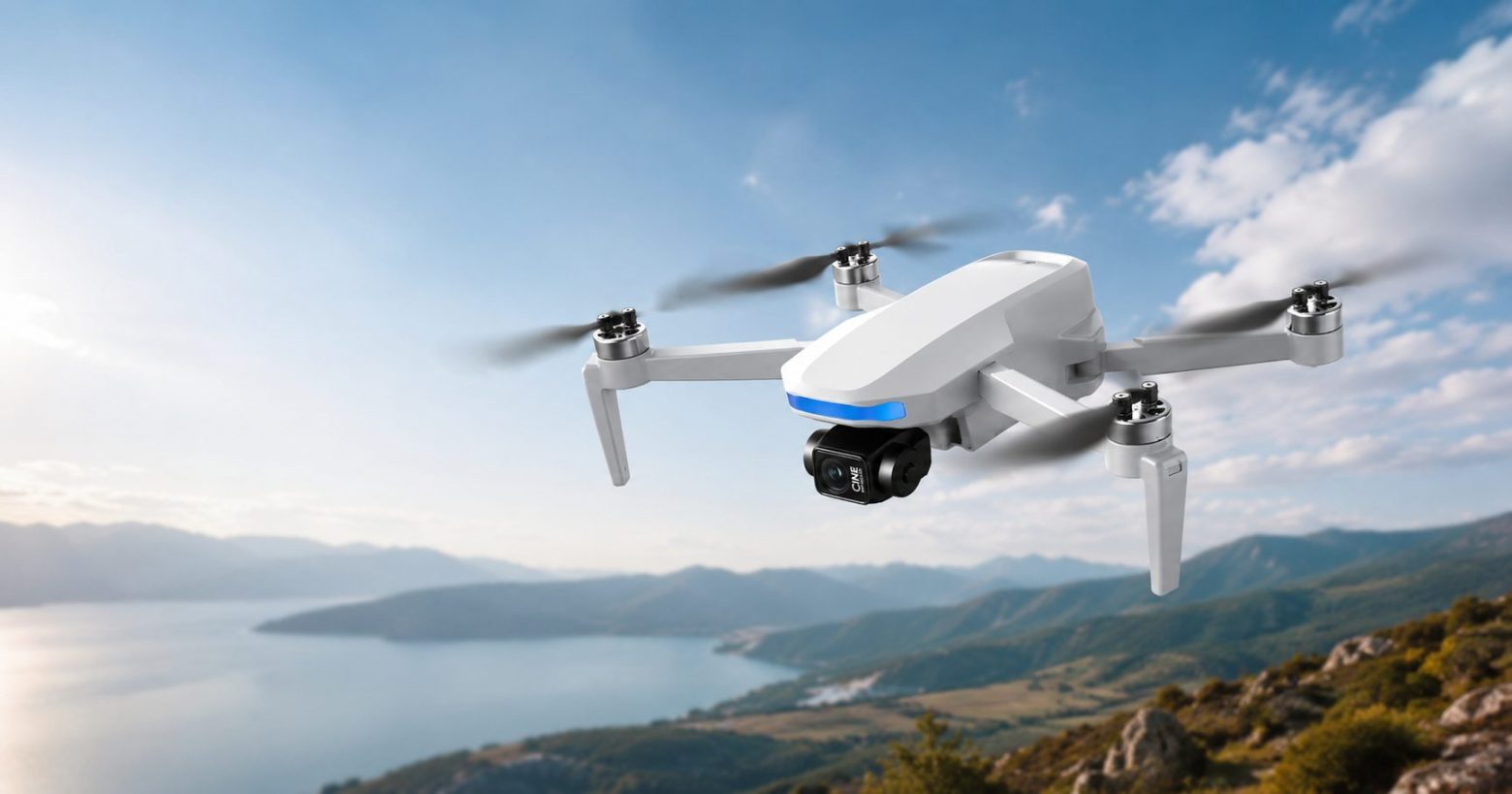
The S-X1 still has a clear reason to exist. Its 3-axis gimbal, EIS, approximately 30-minute endurance, and longer video link make it the camera-first option. GT6 is the lighter, lower-priced, better-documented range choice with a 5.64-inch screen. Your decision is therefore not “2 km versus 5 km.” It is complete and balanced range information versus stronger camera hardware and a longer video link.
Range Clarity or Gimbal Hardware?
This comparison does not treat the largest distance as an automatic win. For a beginner, “best” means that the aircraft fits a manageable first-flight routine and that the buying decision can be supported by comparable information. The main criteria are control and video range, controller viewing, camera stabilization, endurance, aircraft weight, package price, and the limits attached to each number.
Predictability carries extra weight in a beginner comparison. GT6 earns the broader recommendation because its specifications include a matched command-and-video range pair, identify the controller display, and start at a lower price. These are maximum values for suitable open conditions, so obstacles and radio interference can shorten them. The important point is that the relevant fields can be read together without filling in a missing control number.
The camera-first result uses a different criterion. S-X1 pairs a 3-axis mechanical gimbal with EIS, while GT6 specifies EIS but no 3-axis gimbal. That hardware difference supports a recommendation for buyers who prioritize smoother camera control. It does not establish measured image quality, wind performance, or a five-kilometer control range.
Define Long Range First
“Long range” can describe at least three different things on a drone page. Control range is the published distance over which the remote can send flight commands. Video-transmission distance is the published distance over which the controller can continue receiving the camera feed. Usable operating distance is the much shorter, situation-dependent distance at which you can still see the aircraft, understand its orientation, maintain a safe return margin, and comply with the rules that apply to the flight.
Those three limits do not automatically match. A video link can remain available even when the aircraft is too far away for a beginner to judge its orientation with unaided vision. A control system can also remain connected after the video feed becomes difficult to use. Battery and wind may force the return before either radio link reaches its published maximum. Our separate guide to how far a GPS drone can fly explains those definitions in more depth; this page uses them only to compare S-X1 and GT6.
For U.S. recreational flying, the specification is not permission to send the aircraft to the number printed on the page. The FAA states that recreational operators must keep the drone within visual line of sight, either directly or with a co-located visual observer in direct communication. That means a longer radio link is best understood as technical headroom: it may support a steadier connection within your legal and safe operating area, but it is not a beginner distance target.
Range Numbers Side by Side
| Attribute | GT6 | S-X1 | What It Means |
|---|---|---|---|
| Listed control range | Up to 2,000 m | To Be Confirmed | GT6 provides the complete control figure; S-X1 does not currently provide a verifiable control-range value |
| Listed video transmission | Up to 2,000 m, WiFi transmission | Up to 5,000 m, digital transmission | S-X1 has the longer listed video link, but this is not a 5,000 m control claim |
| Controller display | 5.64-inch built-in screen | Built-in screen; exact size To Be Confirmed | GT6 has the clearer screen-size specification |
| Camera stabilization | 4K with EIS | 4K with 3-axis gimbal plus EIS | S-X1 has the more camera-focused listed stabilization system |
| Listed flight time | About 25 minutes | About 30 minutes | Conditions are not normalized, so treat the five-minute difference as provisional |
| Battery | 7.4 V, 1,300 mAh | 7.4 V, 1,600 mAh | Capacity alone does not prove real-world endurance |
| Listed aircraft weight | 209 g | 237 g | GT6 is 28 g lighter before any unconfirmed accessory or configuration changes |
| Price checked Aug. 18, 2026 | $388–$568 | $538–$618 | Package and battery options differ; compare the selected configurations before paying |
This table deliberately leaves the S-X1 control range unfilled. Replacing it with 5,000 meters would make the comparison look cleaner, but it would also change the meaning of the available specification. The correct value is “To Be Confirmed” until the S-X1 manual or updated technical sheet provides the control distance under stated conditions.
Read the figures in rows rather than as a single score. GT6 supplies a matched pair for command and video, so the radio specification is easier to evaluate. S-X1 supplies the stronger stabilization package and the longer video figure, but one range field remains open. A large number in one row cannot compensate for a missing value in another. The right comparison keeps every attribute attached to the entity it actually describes.
The words “up to” also matter. They describe a ceiling reached under favorable conditions, not a minimum service level. Flight altitude, surrounding radio traffic, antenna alignment, terrain, and weather all affect the result. For a beginner, the numbers are useful for comparing the two radio systems, but they should not be used to draw a guaranteed radius around a launch point.
The Missing S-X1 Number
The largest number in this comparison is also the easiest one to misuse. S-X1 is rated for digital image transmission up to 5,000 meters, but its technical information does not give a separate control-range value that can be compared with GT6 on the same basis. Video transmission describes the live-view link. It does not, by itself, tell you how far flight commands remain supported.
Three possibilities exist: the control limit could match the video figure, it could be shorter, or it could be defined under a different test condition. Until that value is confirmed in the technical sheet, the 5,000-meter figure should be treated only as the video-transmission distance.
This does not make the 5,000-meter video figure useless. It still indicates that S-X1 is designed around a longer digital viewing link. Within a much shorter visual operating area, link headroom can be valuable when the site has ordinary radio noise or when the camera view is central to framing. Yet the figure should support a camera-monitoring decision, not an unsupported claim that S-X1 is controllable for five kilometers.
If maximum controllable distance is the deciding purchase field, request the latest S-X1 manual or written specification before ordering. Confirm the control frequency, control range, video range, conditions used for both values, and what the aircraft is documented to do after control-signal loss. Until then, GT6 has the more complete range specification.
GT6: Matched Range and Screen
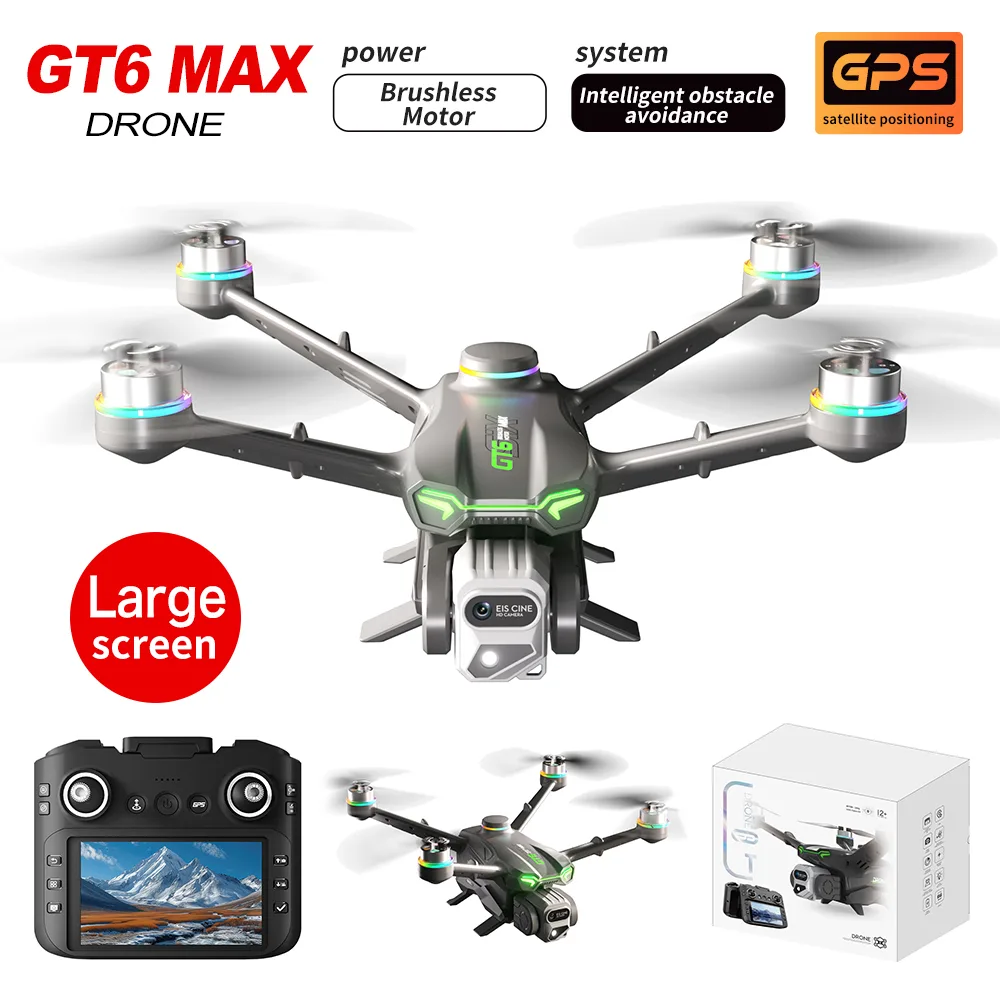
The strongest GT6 argument is not that 2,000 meters is a safe beginner route. It is that GT6 is rated for a 2,000-meter control distance and a 2,000-meter video-transmission distance. The live-view limit is designed to keep pace with the command link instead of ending at a much shorter distance.
GT6 also gives the controller a clear identity. Its 5.64-inch built-in display is large enough to be a central part of the product rather than a small status panel. You do not need to mount a phone for the primary live view. The drone adds 4K imaging with EIS, GPS positioning with return support, a 2100KV 1503 brushless motor specification, and approximately 25 minutes of flight time.
Buildings, terrain, radio interference, antenna orientation, weather, and battery condition can reduce the usable distance. Screen brightness, video latency, return speed, and wind strength also affect how comfortable the aircraft feels near the edge of a flight area. GT6 is easier to understand because its core range figures are complete and balanced, not because every flight will reach 2,000 meters.
S-X1: Gimbal and Video Link
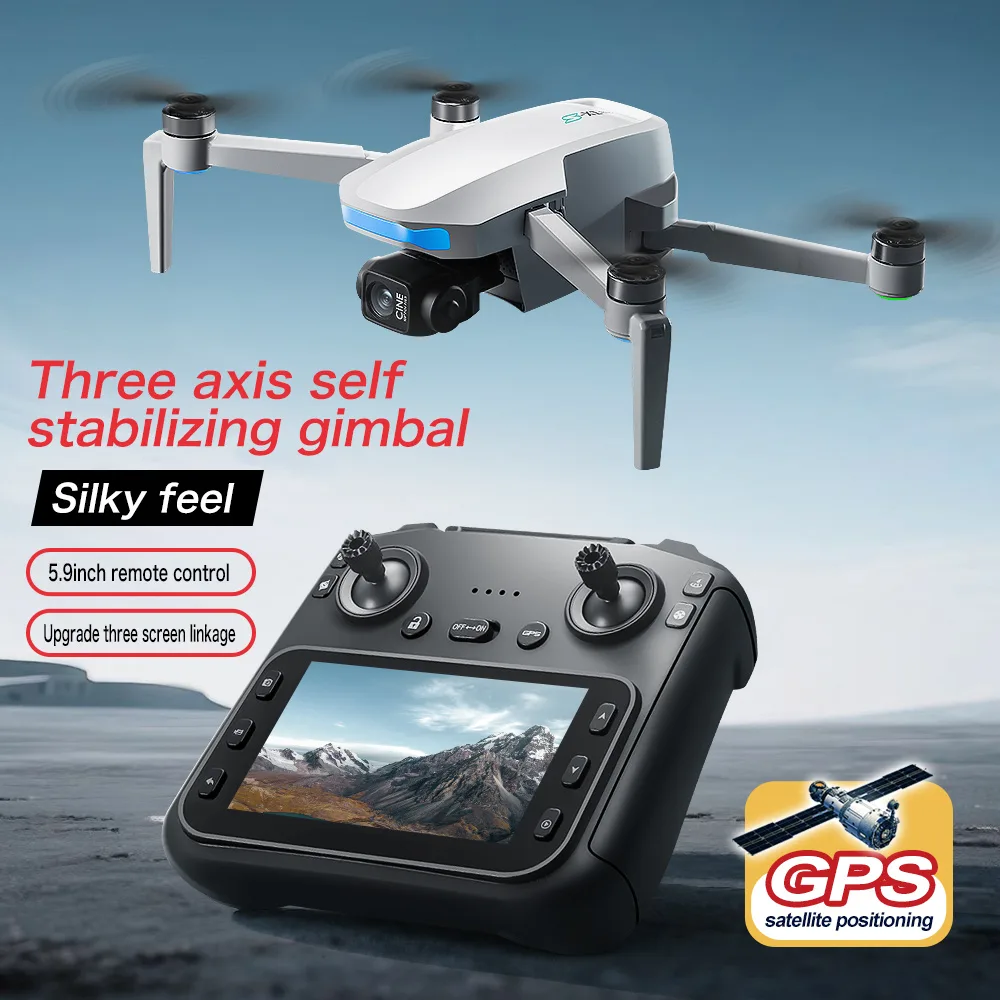
S-X1 spends its extra cost on a different combination. Its camera system includes a 3-axis mechanical gimbal plus EIS, while digital video transmission is rated up to 5,000 meters. The aircraft weighs 237 grams and uses a 7.4 V, 1,600 mAh battery, with flight time given as about 30 minutes. It also includes GPS positioning, multiple return functions, brushless motors, a foldable body, and a built-in screen remote.
That makes S-X1 the more specialized option for a buyer whose first priority is controlled camera movement and a screen-centered shooting workflow. A 3-axis gimbal and EIS are two separate stabilization tools: the gimbal physically manages camera orientation, while EIS processes image movement electronically. The combination gives S-X1 the stronger stabilization hardware, although the visible difference will still change with wind, flight speed, camera movement, and shooting direction.
The tradeoff is uncertainty in the fields that matter most to a strict long-range comparison. The S-X1 specification gives a 5,000-meter digital video-transmission figure but not a separate control range. It also confirms a built-in screen, while the available screen-size information is inconsistent. For that reason, S-X1 is shown here as a built-in-screen model without assigning it an exact display size.
Buy S-X1 for the gimbal system, longer video link, and camera-first package. Do not buy it solely because “5,000 m” sounds like a longer controllable route. The 5,000-meter specification applies to video transmission, not a confirmed control distance.
Screen Size Is Not Everything
GT6 has the better-documented controller display: 5.64 inches. S-X1 has a built-in screen remote, but the available materials do not give one consistent size that should be repeated as a verified fact. If a documented display size is one of your top requirements, GT6 is the clearer choice from the available specifications.
Display size is only the beginning of outdoor usability. Brightness, glare, resolution, live-view frame rate, latency, antenna design, battery life, and menu clarity can matter as much as diagonal size. Those values have not been normalized for this comparison. The 5.64-inch figure gives GT6 the better-documented display; it does not prove how either controller performs under direct midday sun.
Both products reduce dependence on a separate phone for the primary viewing experience. That can simplify setup and preserve the phone battery for calls, maps, or emergency use. For a wider comparison of controller displays, see our guide to drones with built-in screen remotes.
A built-in screen is especially useful during repeated practice flights because the controller remains one self-contained system. There is no phone clamp to adjust, no incoming call covering the live view, and no need to check whether a particular phone fits the mount. That convenience does not remove preflight work: the controller still needs to be charged, the display settings checked, and the antennas positioned as the manual directs.
Before choosing by screen alone, ask how you will use the view. A beginner mainly needs to read battery status, GPS state, distance, warnings, and framing without searching through the interface. Someone buying for video may care more about judging horizon level and composition. GT6 has the documented size advantage; a final controller verdict would still require the missing brightness, resolution, latency, and runtime measurements for both models.
Stabilization Changes the Decision
A long video link is useful only if the footage and framing serve your purpose. GT6 lists a 4K camera with EIS and remote electric angle adjustment. S-X1 lists 4K, a 3-axis gimbal, and EIS. The difference is not simply “good versus bad.” It is a choice between a lighter, less expensive electronic-stabilization package and a more camera-focused system with mechanical stabilization.
For learning GPS flight, exploring a local open area, and recording ordinary travel clips, GT6 offers the more balanced purchase. Its camera system is not the only reason to buy it; the large screen, matched range specifications, lower weight, and lower starting price carry equal weight.
For slow landscape passes, planned reveals, or aerial B-roll where camera steadiness is the main reason to own the drone, S-X1 has the more relevant hardware. The 3-axis gimbal creates a real structural distinction from GT6. Still, do not convert that distinction into a claim about measured image quality, wind performance, horizon stability, or low-light results without original footage captured under the same conditions.
This is where a specification-only comparison reaches its boundary. The equipment tells us which model is designed to prioritize stabilization. Only matched raw clips can show how large the visible difference is.
Battery Time and Return Margin
S-X1 lists about 30 minutes from a 1,600 mAh battery. GT6 lists about 25 minutes from a 1,300 mAh battery. The five-minute gap is useful for positioning the products, but the available pages do not provide a shared test protocol, wind condition, flight speed, payload, landing threshold, or battery-age condition. The values should not be presented as a controlled five-minute advantage.
For a beginner, usable flight time is not the number shown at takeoff and it is not the last possible minute before forced landing. It is the time remaining after reserving enough energy to fly back against the actual wind, correct a poor approach, and land at a reachable site. The farther the outbound route, the more the return reserve matters.
Both products include GPS return support, but return-to-home does not create battery power or remove a headwind. It also depends on the model’s documented behavior, a usable GPS state, a recorded home point, and a return path that does not introduce a new obstacle. Read our return-to-home guide for the feature explanation; for this purchase decision, the rule is simpler: use the advertised endurance as planning context, not as the entire route budget.
A multi-battery package extends the total session, not the safe duration of one flight. It can be the better purchase for practice because it gives you several shorter opportunities to learn the controller, verify the home point, and review footage instead of trying to extract every minute from one battery.
The most useful comparison is therefore not “25 minutes versus 30 minutes” in isolation. It is how much calm, repeatable practice each package can support while preserving a conservative return reserve. Two GT6 batteries could provide more total field time than one S-X1 battery even though the S-X1 has the longer single-flight specification. Conversely, a buyer who wants fewer battery changes during a planned camera sequence may prefer the S-X1 position. Confirm the exact number of batteries in the selected package; do not infer it from the displayed price range.
Weight, Packs, and Accessories
GT6 weighs 209 grams and S-X1 weighs 237 grams, giving GT6 a 28-gram advantage before any accessory or configuration change. Both are foldable, and both fit the compact travel role in the RCDronego range. GT6 is the simpler choice when controller size, bag weight, and a lighter aircraft matter more than the gimbal.
Do not treat the aircraft weight as the complete packed weight. The controller, storage bag, spare batteries, cables, card reader, propellers, and tools determine what you carry to the field. S-X1 and GT6 are offered with different battery-package choices, so compare the exact package rather than the lowest number shown beside the product name.
GT6 also lists support for an optional obstacle-avoidance head. That module is not confirmed as standard in every package, and its installed effect on takeoff weight is not provided in the available data. It should not decide this long-range comparison. If you want it, confirm inclusion, sensor direction, operating limits, and final configured weight before ordering.
The Open-Field Range Conflict
Imagine a first outing at a broad rural field. The site looks open, the controller shows a clean image, and the specification suggests far more link distance than you expect to use. GT6 gives you matched 2,000-meter control and video figures. S-X1 gives you a 5,000-meter video link, a gimbal, and a slightly longer battery-time figure. On paper, both appear to leave enormous room.
The real limit arrives earlier. The aircraft becomes difficult to read against the background. A line of trees blocks part of the horizon. The outbound leg had a tailwind, which means the return will face a headwind. The live view still looks stable, but that does not tell you how much ground speed the aircraft can preserve on the way back. More radio headroom does not solve those problems.
In this situation, GT6’s complete range pair makes the purchase easier to understand, while S-X1’s gimbal may produce the more camera-focused setup. Neither specification changes the correct first-flight plan: stay close, confirm normal GPS and home-point behavior, observe battery loss, keep the aircraft visually understandable, and return while conditions are still ordinary.
Price and Package Position
On August 18, 2026, GT6 was priced from $388 to $568, while S-X1 was priced from $538 to $618. Prices can change, and the ranges reflect different battery configurations. The bottom of one range may therefore not represent the same box contents as the top or bottom of the other.
GT6 is the stronger value when your purchase priorities are a documented 5.64-inch controller, matched 2,000-meter control and video distances, 4K with EIS, and a lighter aircraft. It enters at a substantially lower price and still includes the GPS and screen-remote features that define this comparison.
The S-X1 premium pays for the 3-axis gimbal, larger-capacity battery, longer endurance specification, and 5,000-meter digital video-transmission system. That premium makes sense only when those camera and monitoring attributes are central to the way you plan to use the drone. It is harder to justify if the main goal is simply learning GPS flight in a nearby open field.
Compare like with like before checking out: number of batteries, storage bag, memory card, card reader, spare propellers, charger or USB cables, optional modules, and the current controller specification. Package clarity can be worth more than a small difference in the headline price.
Separate the purchase into required and optional value. The required layer is the aircraft, its compatible controller, one working battery, charging method, and the items needed for a normal first flight. The optional layer includes extra batteries, a carrying case, accessory sensors, and convenience items. Comparing those layers prevents an inexpensive base package from appearing equivalent to a higher-priced bundle that is ready for a longer practice session.
Also leave room in the budget for replaceable parts and routine field needs. Spare propellers, a suitable memory card, and a safe way to transport and charge batteries can affect the ownership experience more often than the last few hundred meters of an advertised link. At these prices, GT6 remains the value leader. S-X1 remains the purposeful upgrade only when the gimbal and longer video system are features you expect to use.
Which One Fits Your First Flights?
GT6 fits the broadest beginner use case. Choose it when you want to learn outdoor GPS flight, prefer a documented large display, value a lighter aircraft, and want both the control and video range published on the same basis. It is also the better choice when price matters and a 3-axis gimbal is not essential.
S-X1 fits the camera-first beginner. Choose it when smoother camera movement is the reason you are buying, you want the 3-axis gimbal plus EIS, and the longer digital video link supports your monitoring priorities. Before ordering, obtain confirmation of the control range and controller-screen specification.
Choose neither by range alone. If you have not flown a GPS drone before, a shorter local route with predictable wind, open visibility, and generous battery reserve will teach you more than a maximum-distance attempt. The best long-range GPS drone for a beginner is the one that maintains a clear link inside the route you can actually manage—not the one with the largest isolated number.
For readers comparing the best long-range GPS drones for beginners, the choice comes down to range information and camera priorities. Pick GT6 for the clearer all-around range package. Pick S-X1 for the stronger stabilization hardware and longer video transmission, subject to confirmation of the missing control and screen details. If neither split matches your priorities, compare all GPS drones before moving to checkout.
S-X1 and GT6 Buying Questions
Charging time is about 120 minutes for one battery on either model. The actual time can vary with the power source, cable, battery temperature, and battery condition, so follow the charging instructions supplied with the selected model.
Yes. Both models are available with one-, two-, and three-battery package choices. Package availability and pricing can change, so confirm the selected battery count in the cart before paying.
Both models include a remote controller, aircraft battery, spare propeller blades, USB charging cable or cables, screwdriver, manual, memory card, card reader, and storage bag. Battery count and minor accessories can differ by configuration, so use the selected package and packing list as the final reference.
Compare the current configurations before ordering. Check the selected battery package, controller specification, included accessories, and every value marked To Be Confirmed. GT6 is the lower-cost balanced choice; S-X1 is the gimbal-focused upgrade.