FPV vs Regular Drone for Beginners: Which to Choose
Bywpdev
For most beginners, a regular drone is the easier first choice because it usually offers a calmer flying view, GPS positioning, return-to-home, and a screen or app-based camera view that is easier to understand. An FPV drone is better if you specifically want an immersive first-person flying experience and are willing to practice more carefully. The simple rule: choose a regular GPS drone if you want stable outdoor photos, easier recovery, and beginner confidence; choose an FPV drone if the flying experience itself matters more than camera framing, GPS range, or automatic return features.
Choosing between an FPV drone and a regular drone can be confusing for a first-time buyer. Both can show you a live camera view. Both can be fun outdoors. Both may look beginner-friendly in product photos. But they feel very different once you start flying.
An FPV drone is built around the feeling of flying from the drone’s point of view. A regular drone is usually built around stable control, easier camera framing, and practical outdoor features like GPS positioning and return-to-home. This guide explains the difference in plain English, so you can choose the drone type that fits your first-flight goal instead of buying the wrong style of aircraft.
FPV vs Regular Drone: The Core Difference
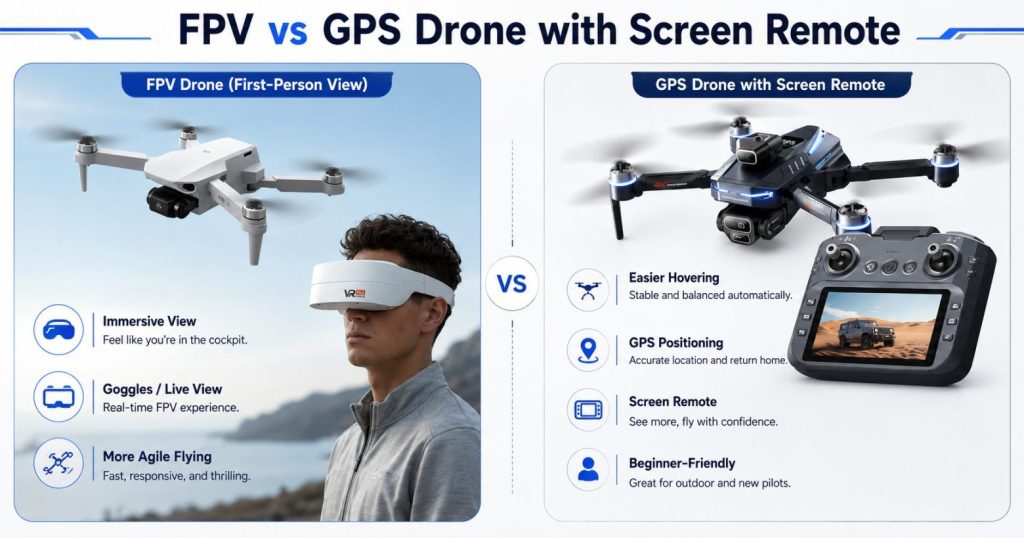
The biggest difference is not only the camera. It is the way you experience the flight.
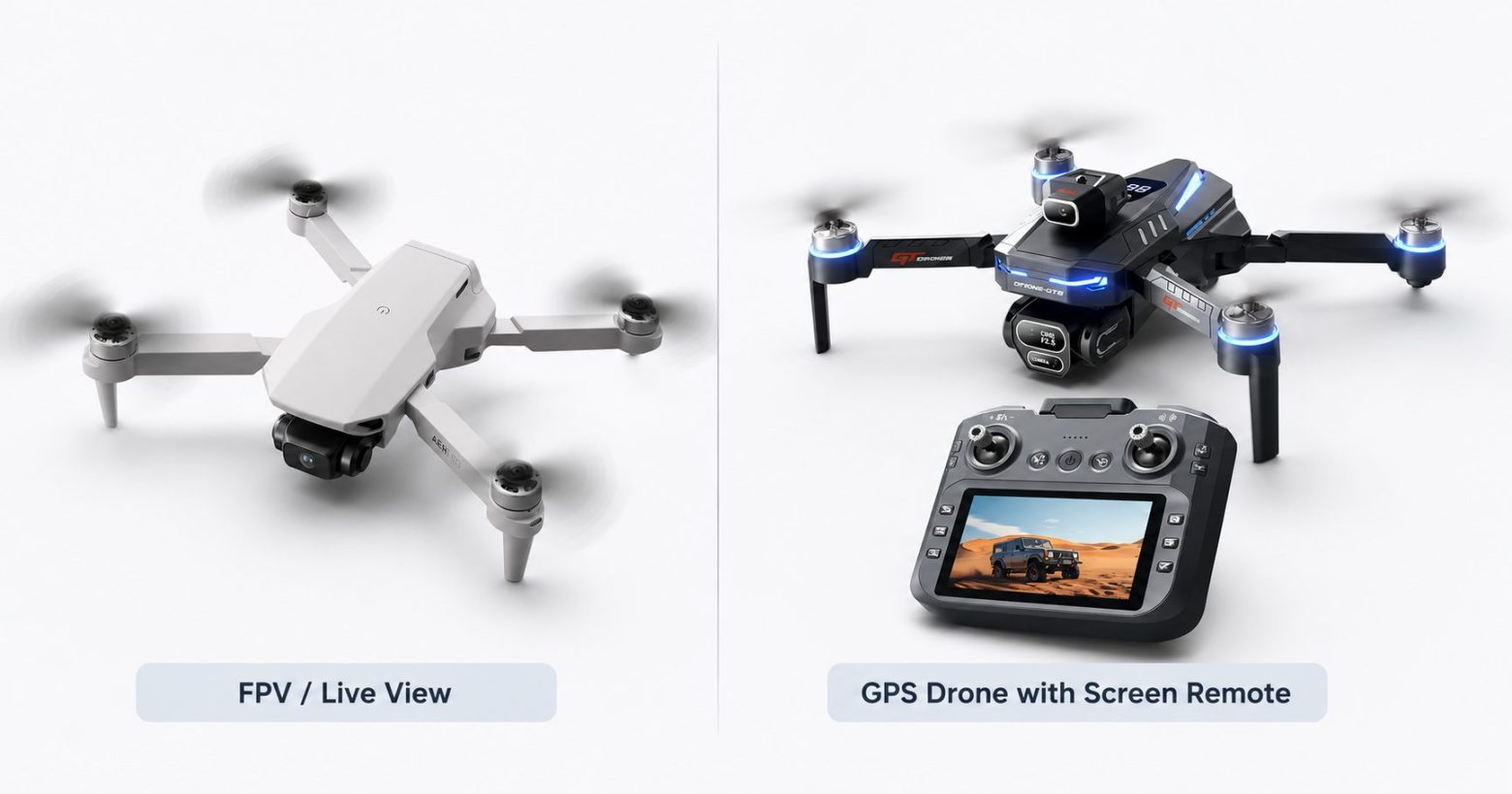
An FPV drone, short for first-person view drone, sends a live camera view from the drone to your phone, screen, or FPV goggles. The goal is to feel like you are flying from inside the drone. This makes FPV flying more immersive and more active.
A regular drone is usually flown by watching the drone in the sky while also checking the camera view on a phone, screen remote, or controller display. Regular beginner drones often focus more on GPS positioning, return-to-home, optical-flow hovering, foldable portability, and easy outdoor camera framing.
| Question | FPV Drone | Regular Drone |
|---|---|---|
| Main experience | Immersive first-person flying | Stable viewing and easier camera control |
| Typical viewing method | Phone, FPV screen, or VR/FPV goggles | Phone app or built-in screen remote |
| Beginner learning curve | Usually steeper | Usually easier |
| Best use | Fun flying, FPV practice, immersive viewing | Outdoor photos, travel clips, GPS-assisted flight |
| Common safety feature | Optical flow or altitude hold on beginner models | GPS positioning and return-to-home on GPS models |
How FPV Flying Feels Compared With Screen-Remote Drone Flying
FPV flying feels more like piloting through the camera. The live view becomes the center of the experience. This is why many FPV drones are fun even when they are not designed for long-range GPS flight or professional aerial video.
A regular screen-remote drone feels calmer. You can look at the drone, check the live view, adjust the camera angle, and make slower flying decisions. For a beginner who wants travel footage, family clips, park flying, or simple outdoor practice, that calmer style is often easier.
The Aeri 100 VR FPV Foldable Brushless Drone is a good example of a beginner-friendly FPV-style option. It is positioned around VR flying glasses, dual-camera FPV viewing, optical-flow positioning, altitude hold, and lightweight brushless flight. It should not be treated as a GPS route drone or a long-range camera platform.
Beginner Control: FPV Practice vs GPS Return-to-Home
For beginners, control confidence matters more than the label on the box. FPV drones and regular GPS drones usually build that confidence in different ways.
A beginner FPV drone may use optical flow positioning, altitude hold, headless mode, and speed modes to make low-altitude practice easier. These features help the drone feel more manageable, especially when the pilot is learning how the camera view matches the drone’s movement.
A regular GPS drone builds confidence differently. GPS positioning helps the drone hold its place outdoors. Return-to-home gives the pilot a recovery option if the drone gets too far away, loses signal, or needs help getting back. For a deeper explanation of that safety feature, read our GPS drone return-to-home guide.
Beginner safety note: FPV view does not replace awareness of the drone’s position. In the U.S., recreational flyers must keep the drone within visual line of sight, or use a co-located visual observer when flying first person view. Rules vary by country, so always check local requirements before flying.
Camera Use: FPV View vs Regular Aerial Framing
This is where many beginners choose the wrong drone type. FPV view and camera-drone view are not the same experience.
FPV is about seeing what the drone sees while it moves. It is great for flying through open spaces, practicing direction control, and enjoying a more connected flying feeling. On beginner FPV drones, the camera is often best understood as a live-view and casual recording tool, not as a full aerial filmmaking system.
A regular camera drone is usually better when your main goal is to frame a landscape, record a travel scene, or take smoother outdoor video. Regular GPS drones may include screen remotes, adjustable camera angles, EIS, or even gimbal stabilization on higher models.
| Your Main Goal | Better First Choice | Reason |
|---|---|---|
| Feel like you are flying from the drone | FPV drone | First-person view is the main experience |
| Take outdoor photos and travel clips | Regular GPS drone | Easier camera framing and stable positioning |
| Practice low-altitude flying for fun | Beginner FPV drone | Optical flow and altitude hold can help |
| Use return-to-home as a safety net | Regular GPS drone | RTH requires GPS positioning |
| Get smoother video footage | Regular camera drone | EIS or gimbal support matters more |
Where an FPV Drone Makes More Sense for a Beginner
An FPV drone makes more sense when the buyer is choosing the drone for the flying experience itself. You are not just trying to capture a nice view. You want to feel the direction changes, practice low-altitude control, and watch the flight from the drone’s perspective.
A beginner FPV drone is especially suitable when:
- You want a more immersive first-person flying experience.
- You like the idea of VR or FPV-style viewing.
- You plan to fly in open spaces at low altitude while practicing control.
- You care more about fun flight interaction than long GPS range.
- You understand that optical flow support is not the same as GPS return-to-home.
For this type of user, Aeri 100 fits a clear role: lightweight VR FPV practice with brushless power, optical-flow positioning, dual-camera viewing, and a compact foldable body. Its listed control distance and WiFi image transmission range should be treated as beginner FPV practice limits, not as long-range GPS-drone performance.
Where a Regular GPS Drone Is the Better Beginner Choice
A regular GPS drone is the better first choice when the buyer wants a practical outdoor camera drone. This includes travel videos, park flights, family footage, landscape shots, and slower flying where return-to-home and position hold reduce stress.
Regular GPS drones are especially suitable when:
- You want GPS positioning to help the drone hold steady outdoors.
- You want return-to-home as a recovery feature.
- You want a built-in screen remote or easier camera framing.
- You want longer listed control range or video transmission distance.
- You care more about stable photos and videos than immersive FPV feeling.
For example, the GT6 GPS drone is a regular GPS-style option with a 5.64-inch screen remote, GPS and optical-flow support, 4K with EIS, and listed control and video transmission distance up to 2000 m under specified conditions. Actual performance can vary by wind, battery condition, interference, terrain, and pilot behavior.
RCDronego Lineup: FPV Drone vs Regular GPS Drone Roles
The easiest way to avoid buying the wrong drone is to separate product roles. An FPV drone is not automatically a better camera drone. A GPS camera drone is not automatically a better FPV drone. They are built around different beginner experiences.
| Model / Type | Main Role | Confirmed Beginner-Relevant Specs | Best Fit |
|---|---|---|---|
| Aeri 100 VR FPV | Beginner FPV / VR flying | 136g body, optical flow, altitude hold, dual-camera FPV viewing, about 10 min flight time, about 100 m control distance, about 30-50 m WiFi image transmission | Immersive FPV practice and casual fun flying |
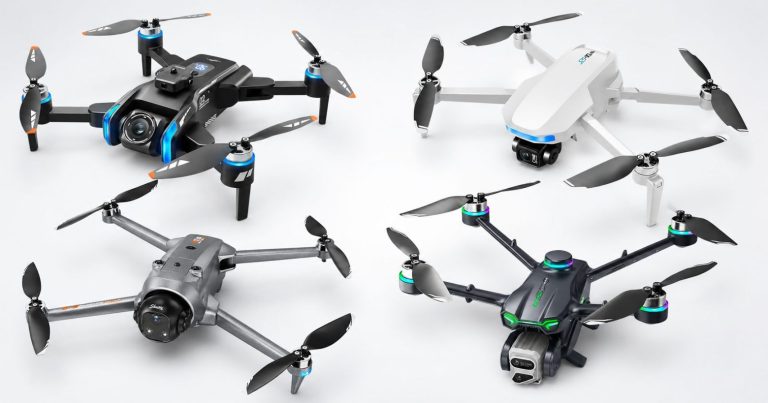
| XT606 GPS drone | Entry GPS camera drone | 223g, 4.3-inch screen remote, GPS + RTH, 4K front camera, brushless motor, about 25 min listed flight time, 500 m control / 300 m transmission | Lowest-cost regular GPS flying |
| GT6 GPS drone | Range and screen upgrade | 209g, 5.64-inch screen remote, GPS + optical flow, 4K + EIS, about 25 min listed flight time, 2000 m control / 2000 m transmission | Regular outdoor GPS flying with stronger range |
| XT808 GPS drone | Large-screen beginner setup | 227g, 5.9-inch screen remote, 4K, 180-degree lens, GPS + optical-flow positioning, foldable body | Regular beginner camera flying with large live view |
Use the table as a role map, not as a promise of real-world distance or flight time. Listed values depend on package, conditions, battery health, wind, signal interference, and flying style.
Which Should a Beginner Buy First?
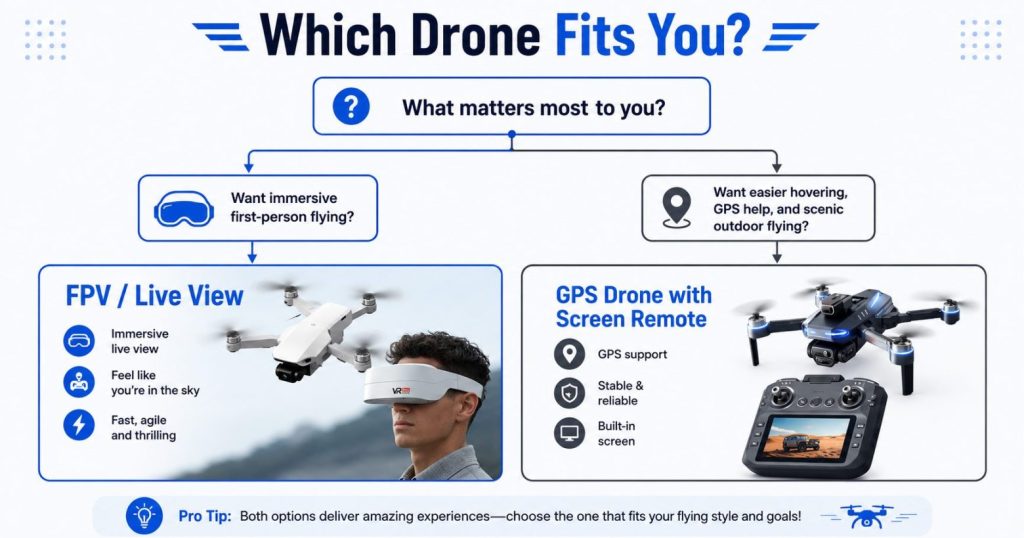
For most first-time buyers, the better first drone is a regular GPS drone. It gives you a more forgiving learning path, especially outdoors. GPS positioning, return-to-home, screen remote options, and stable camera framing make early flights less stressful.
Choose an FPV drone first only when you know you want the first-person flying experience more than GPS recovery, long transmission distance, or polished aerial framing. FPV is not wrong for beginners, but it asks more from the pilot.
- Choose a regular GPS drone if you want outdoor photos, return-to-home, screen remote viewing, and a calmer learning curve.
- Choose an FPV drone if you want a more immersive flight view, VR-style fun, and closer practice flying.
- Do not choose FPV only because it sounds more advanced. Choose it because you actually want the first-person flying style.
First-Flight Checklist for FPV and Regular Drone Beginners
Before the first flight, the checklist should match the drone type. FPV beginners and GPS drone beginners do not need the exact same first-flight habits.
| Before Flying | FPV Drone Beginner | Regular GPS Drone Beginner |
|---|---|---|
| Viewing method | Confirm phone, screen, or goggles are connected before takeoff | Confirm screen remote or app live view is working |
| Positioning | Check optical flow / altitude hold behavior at low altitude | Wait for GPS positioning and home point before flying farther |
| Practice area | Use a wide open area with no people, wires, trees, or glass nearby | Use a wide open outdoor area with clear sky for GPS |
| Distance | Stay close while learning FPV orientation | Stay within sight and do not chase rated maximum range |
| Recovery habit | Land early if the view becomes confusing | Understand return-to-home before relying on it |
For a regular GPS starting point, browse the GPS Drones collection and compare models by screen size, GPS support, return-to-home, camera type, listed distance, and battery package.
Frequently Asked Questions
Is an FPV drone harder to fly than a regular drone?
For most beginners, yes. FPV flying can feel harder because you are making decisions from the drone camera view, which changes how direction and distance feel. A regular GPS drone is usually easier for a first flight because you can watch the drone directly, use the live camera view for framing, and rely on GPS positioning and return-to-home on supported models.
Should a beginner start with an FPV drone or a regular GPS drone?
Most beginners should start with a regular GPS drone if they want easier outdoor flying, return-to-home, and stable camera framing. A beginner should start with an FPV drone only if the main goal is immersive first-person flying and they are willing to practice carefully at close range.
Does an FPV drone have GPS return-to-home?
Some FPV drones may include GPS, but many beginner FPV-style drones focus on optical flow, altitude hold, app viewing, or goggles instead of GPS return-to-home. Do not assume an FPV drone has return-to-home. Check the model specifications before buying.
Is FPV better for drone video?
FPV is better for an immersive flying view, but not always better for normal aerial video. A regular camera drone is usually easier for landscapes, travel clips, and stable framing. For smoother video, stabilization, camera angle control, and GPS stability may matter more than FPV view alone.
Do I need goggles to fly an FPV drone?
Not always. Some FPV drones use a phone or app live view, while some versions include VR or FPV flying glasses. Goggles make the flight feel more immersive, but they also reduce your ability to see the surrounding airspace directly, so beginners should use extra caution and follow local line-of-sight rules.
Which RCDronego drone is better for FPV practice?
For FPV-style practice, Aeri 100 is the clearer fit because it is positioned around VR FPV viewing, dual-camera live view, optical-flow positioning, altitude hold, and lightweight brushless flight. For regular outdoor GPS flying, models such as XT606, GT6, and XT808 are better fits because they focus on GPS positioning, screen remote viewing, and return-to-home support.
The Bottom Line
In the FPV vs regular drone decision, most beginners should choose a regular GPS drone first if they want easier outdoor control, return-to-home support, and calmer camera framing. Choose an FPV drone first if your main goal is immersive first-person flying and you are ready to practice slowly, stay close, and understand the viewing limits. FPV is more exciting; a regular GPS drone is usually more forgiving. The better beginner choice depends on whether you want the flight experience or the easiest path to stable aerial photos and video.