
Can You Fly a Drone at Night?
Bywpdev
Beginner Night-Flight Decision
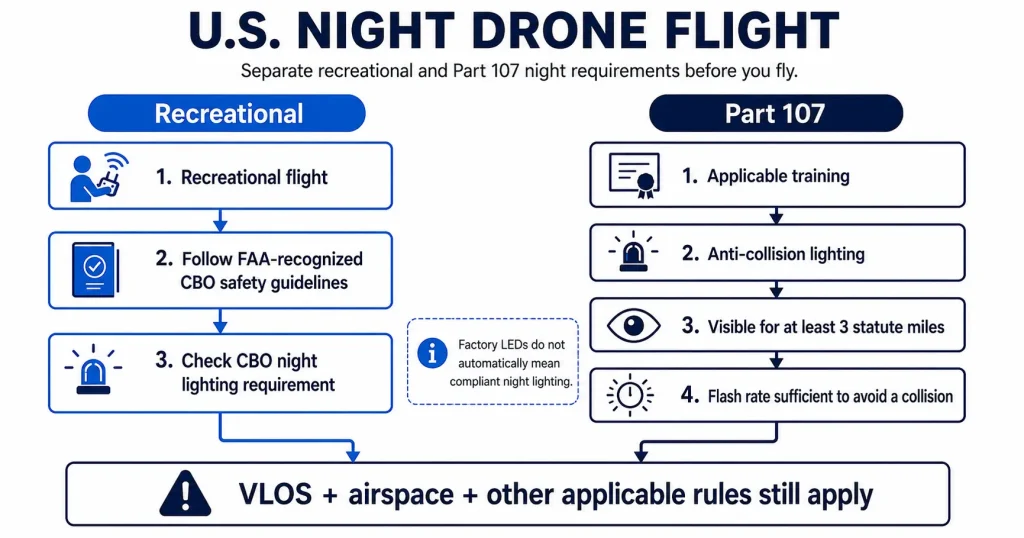
Can you fly a drone at night? In the United States, yes, but the rules depend on how you are flying. Recreational flyers must follow an FAA-recognized Community-Based Organization’s safety guidelines, including its night procedures and required lighting. For routine Part 107 night operations, the remote pilot must complete the applicable updated initial knowledge test or recurrent training, and the drone must use anti-collision lighting visible for at least three statute miles with a flash rate sufficient to avoid a collision. Night does not remove visual-line-of-sight, airspace, altitude, registration, Remote ID, or other rules that apply to the operation.
- Identify whether the flight is recreational or conducted under Part 107.
- Confirm the exact lighting requirement that applies before relying on the drone’s built-in LEDs.
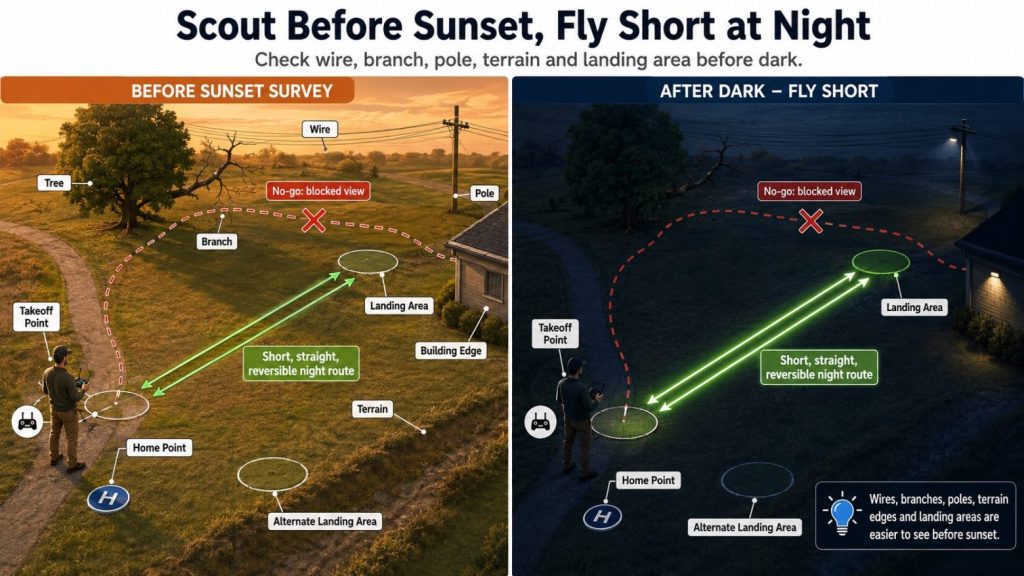
- Scout the site while there is still enough light to identify wires, trees, poles, people, terrain, and a clear landing area.
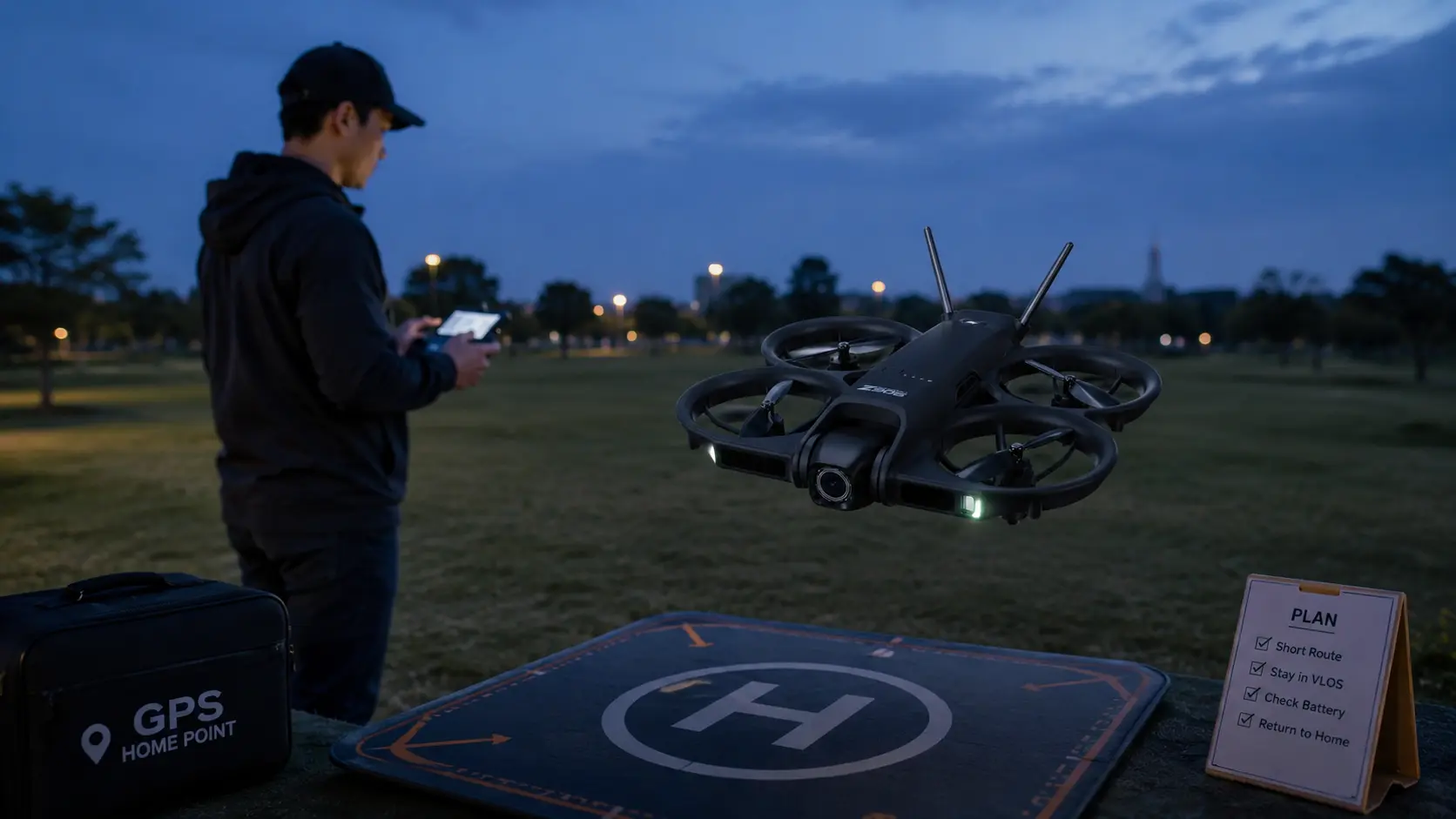
- Confirm GPS, the home point, live view, battery, and manually activated RTH while the aircraft is still close.
- Keep the first night route shorter than the same daytime route and within visual line of sight.
- Return as soon as orientation, lighting, GPS, video, battery, wind, or landing confidence changes.
Night flying changes the pilot’s limiting factor. During the day, a beginner may be able to see the airframe, estimate its attitude, notice a tree line, and judge whether the drone is moving toward or away from a hazard. After dark, the controller may still show a clean live view and GPS may still report a normal position, while the pilot’s direct visual understanding of the aircraft and its surroundings has become much weaker.
That difference is why this guide is not a night-photography tutorial. The task is to decide whether the flight should happen at all, verify the applicable U.S. rule set and lighting, prepare the route before darkness removes detail, and keep enough visual, battery, and recovery margin to end the flight early.
RCDronego’s supplied product specifications confirm GPS, RTH, cameras, screen remotes, optical flow, EIS, gimbals, range, and obstacle-assistance features on selected models. They do not establish that any model’s built-in light satisfies a recreational CBO night procedure or the Part 107 anti-collision-light requirement. Treat night-light compliance as a separate evidence question.
Can You Fly a Drone at Night in the U.S.? Start With Recreational vs. Part 107 Rules
The first night-flight question is not which camera mode to use. It is which operating rule applies. In the U.S., the FAA currently distinguishes recreational night flying from Part 107 night operations. The FAA’s Getting Started guidance states that recreational flyers flying at night must operate under an FAA-recognized CBO’s safety guidelines with night procedures detailing required lighting. For routine Part 107 night operations, the remote pilot must complete the applicable updated initial knowledge test or recurrent training, and the aircraft must use anti-collision lighting visible for at least three statute miles with a flash rate sufficient to avoid a collision.
That difference matters because a beginner should not borrow the Part 107 lighting sentence and present it as the complete recreational rule, or assume a recreational CBO procedure automatically applies to a commercial operation. Confirm the purpose of the flight first, then read the current rule set that actually governs it.
| U.S. Night Flight | What the FAA Says About Lighting | What Still Needs Checking |
|---|---|---|
| Recreational | Follow an FAA-recognized CBO’s safety guidelines with night procedures detailing required lighting | Current CBO procedure, airspace authorization when required, VLOS, registration/Remote ID where applicable, and local site rules |
| Part 107 | Complete the applicable updated initial knowledge test or recurrent training, and use anti-collision lighting visible for at least three statute miles with a flash rate sufficient to avoid a collision | Current Part 107 eligibility, airspace authorization when required, VLOS and other operating limitations |
Part 107 civil-twilight note: The anti-collision-light requirement also applies during periods of civil twilight. Do not assume that a Part 107 flight is exempt from the lighting requirement simply because some daylight remains.
Night Permission Does Not Override Airspace or Site Restrictions
Being allowed to fly at night does not make every night location legal. Controlled airspace may still require authorization, and a park, beach, campus, event venue, private property owner, wildlife area, or local authority may restrict takeoff, landing, or operating hours. Check airspace and ground access as separate decisions.
Visual Line of Sight Still Applies After Dark
In the U.S., the FAA’s current recreational-flyer guidance requires recreational flyers to keep the drone within visual line of sight or use a visual observer who is co-located with and in direct communication with the pilot. A screen remote or live camera feed does not replace that requirement. At night, a bright live view may show the camera scene while providing much less direct awareness of the aircraft’s orientation, nearby traffic, and hazards outside the frame. Rules vary by country, so always check the requirements that apply where you fly.
Rule boundary: This guide summarizes the FAA distinction relevant to a beginner decision; it does not replace the current FAA regulation, CBO safety code, airspace authorization, or local property rules for your specific flight.
A Drone’s Navigation LEDs Are Not Automatically the Night Lighting Your Operation Requires
Many consumer drones have LEDs for power status, orientation, styling, battery warnings, or low-light visibility. Those lights can help the pilot tell front from back, but the presence of a red, green, blue, or white LED does not by itself prove compliance with the night-lighting rule that applies to the flight.
Separate Orientation Lighting From Regulatory Evidence
An orientation light answers a practical question: “Can I tell which way the aircraft is facing?” A compliance claim answers a different question: “Does this lighting configuration meet the current requirement for this type of night operation?” The second claim needs documentation for the actual light and operating rule. Color, brightness on a product photo, or the word “LED” is not enough evidence.
For recreational flying, check the night procedure of the FAA-recognized CBO you are following. For Part 107 night flying, confirm that the anti-collision light satisfies the FAA requirement applicable to that operation. Do not convert a manufacturer’s decorative-light or orientation-light description into a regulatory claim unless the documentation supports it.
Do Not Add a Light Without Checking Weight, Balance, Mounting, and Visibility
An external light adds mass and can change balance, airflow, folding clearance, camera visibility, GPS reception, or the way the battery latch and shell are accessed. Mounting a light where it blocks the camera, ventilation, GPS area, sensors, propellers, or a folding arm creates a new problem. Any accessory also becomes part of the takeoff configuration, so verify compatibility rather than treating the light as a universal clip-on solution.
Recheck the configured takeoff weight after adding the light. For U.S. recreational flying, an accessory can matter if it pushes a drone that was below 250 g to 250 g or more, because FAA registration and Remote ID requirements may then change. Part 107 aircraft must be registered regardless of weight. Use the aircraft’s actual configured takeoff weight rather than the bare-drone specification.
Confirm the Light Before the Night Flight, Not After Takeoff
- Identify the rule set for the flight.
- Verify the required lighting against current documentation.
- Install the light only in a position that does not interfere with aircraft operation.
- Confirm the light remains secure through normal arm movement and handling.
- Power the aircraft and light on before takeoff and verify that both are operating normally.
- Postpone the flight if the lighting requirement cannot be confirmed.
RCDronego evidence boundary: The supplied product data does not verify Part 107 three-statute-mile anti-collision-light compliance or a specific recreational CBO night-lighting requirement for XT606, GT6, S-X1, AE20 Max, XT808, Aeri 100 VR, Z105, Z4, Z906, or T3.
Scout the GPS Drone Route Before Sunset Removes Ground Detail
A night route should be understood while the site is still easy to read. The camera can brighten a dark scene electronically, but it may not reveal a thin wire, unlit branch, dark pole, uneven ground, shallow ditch, or a person entering from outside the frame. A daylight or dusk walk gives the pilot information that is difficult to reconstruct from the controller after dark.
Identify Obstacles That Will Become Nearly Invisible Later
Look specifically for power and communication lines, tree branches against a dark background, poles, fences, antenna masts, roof edges, cables, light poles, cranes, flags, signs, sloped terrain, and any obstacle that the route could approach during a turn or RTH path. Mark the launch point and look at the route from the pilot’s actual standing position rather than from the camera angle you hope to record.
Do not use “I can see the city lights” as evidence that the flight path is clear. Background lights can make a dark obstacle harder to separate visually, and a bright screen can draw attention away from the aircraft. The route should be simple enough that the pilot already knows what lies between the home point and the farthest planned position.
Choose a Launch Area That Is Easy to Recognize at Night
A good daytime launch area can become ambiguous after dark if it sits among identical parking spaces, patches of grass, rooftops, or paths. Choose open, level ground with enough clearance for takeoff and landing and a distinct visual reference that does not depend on the live camera. Avoid launching under tree cover, beside a dark wall, next to reflective water, or from a narrow location that leaves no room for an offset landing.
Decide the Go/No-Go Boundary Before the Site Gets Darker
Set the farthest point, maximum route complexity, alternate landing area, and the conditions that end the flight before takeoff. A route that depends on seeing an unlit landmark, passing behind a building, following a road beyond the pilot’s direct view, or approaching a crowd should be rejected before darkness makes the decision harder.
| Daylight Scout Item | Why It Matters at Night | Beginner Decision |
|---|---|---|
| Wires and thin branches | Can disappear against a dark sky or background lights | Keep them completely outside the route |
| Launch and alternate landing areas | Ground detail becomes harder to judge | Use open, recognizable dry ground |
| Tree line, buildings, poles, terrain | RTH and manual return still need clearance | Plan a direct unobstructed return path |
| People, vehicles, events, wildlife | Movement may be harder to see from the screen | Move or cancel the route when the area becomes active |
| Ambient lights | Can help orientation but also create glare and visual clutter | Do not rely on them as obstacle markers |
Confirm GPS, the Home Point, and Manually Activated RTH Before the Night Route Extends
GPS and return-to-home can support a night flight on compatible models, but darkness does not make those systems more accurate or more capable. The safest time to discover a missing home point, unreadable status icon, incorrect return altitude, or unfamiliar RTH behavior is while the drone is still close to the pilot and a normal landing remains easy.
Wait for the Model’s Normal GPS and Home-Point Confirmation
Use the aircraft manual to identify the correct GPS-ready and home-point indications. Do not invent a universal satellite count, LED color, spoken message, or screen icon. If the home point is missing, obviously wrong, or changes unexpectedly, land and resolve the setup instead of sending the drone into a darker part of the route.
Verify the Return Path Against Obstacles You Saw Before Sunset
Where the model supports a configurable return altitude, the setting should clear the actual route obstacles while remaining appropriate for the airspace and flight. A high automatic climb can spend battery and enter stronger wind; a low path can place the drone into a tree line, mast, roof, or pole that is difficult to see after dark.
Test Only Manually Activated RTH When the Manual Provides a Safe Procedure
Keep the aircraft over an open, familiar area and test manually activated RTH only when the model documentation provides a safe procedure. Do not intentionally create a signal-loss condition or drain the battery to force low-battery RTH. Those events remove the very margins a beginner is trying to preserve.
The dedicated GPS return-to-home guide owns the full explanation of manual, low-battery, and signal-loss return behavior. For night flying, the boundary is narrower: confirm the correct home point, know the return path, understand how to cancel or take control according to the manual, and return manually before an automatic recovery becomes necessary.
Night RTH boundary: RTH can command a route toward the recorded home point on supported models. It cannot make an unlit obstacle visible, restore battery power, guarantee GPS accuracy, or replace the pilot’s responsibility to maintain visual awareness.
Visual Line of Sight Can Become the Night-Flight Limit Before Transmission Distance Does
A screen remote may continue to show a bright live image after the aircraft itself has become a tiny light with no clearly readable attitude. That is not a reason to keep flying. Control range and transmission distance describe communication capability; they do not define how far a beginner can maintain visual line of sight at night.
Seeing a Light Is Not the Same as Understanding the Drone’s Position and Movement
The pilot must be able to maintain meaningful visual awareness of the aircraft and the surrounding flight environment, not merely confirm that a point of light exists somewhere in the sky. Distance, angle, background lighting, aircraft orientation, haze, glare, and the direction of the LEDs can all change how useful that visual reference is.
If the pilot can no longer confidently determine whether the drone is approaching, receding, turning, climbing, or drifting relative to nearby hazards, the route has already become too difficult for a beginner. Reduce distance before that happens rather than using the screen to continue outward.
Rated Range Is a Capability Margin, Not a Night-Flight Goal
The supplied RCDronego data includes control and transmission figures ranging from hundreds of meters to longer listed distances on selected GPS models. Those figures do not become safe night-flight distances. Interference, terrain, buildings, battery condition, wind, and visual limitations can reduce the usable route long before the rated communication limit.
The GPS drone range guide explains control range, video transmission distance, and visual line of sight as separate limits. At night, the visual limit can become the restrictive one sooner, so a strong video feed should be treated as information—not permission to extend the route.
Keep the Screen Bright Enough to Read, Not So Dominant That You Stop Looking Up
The controller must remain readable, but the pilot should avoid a workflow in which attention stays on the screen for long periods. Check telemetry deliberately, then return attention to the aircraft and surrounding sky. If the display, reflections, notifications, or framing task makes it difficult to maintain direct awareness, shorten the flight or land.
Do Not Assume Optical Flow or Obstacle Avoidance Works the Same in Darkness
GPS, optical flow, and obstacle sensing use different information. A GPS-equipped aircraft may still report satellite positioning at night, while a downward or forward vision-based system may depend on surface detail, contrast, illumination, distance, sensor direction, or other model-specific conditions. Night does not switch every assistance feature off, but it does make assumptions about unverified sensor performance especially risky.
Optical Flow Needs the Conditions Specified for the Exact Drone
Optical flow generally uses visual information beneath the aircraft to help with low-altitude position hold. A dark lawn, uniform pavement, reflective surface, or weakly illuminated ground may provide different visual information from a bright textured floor or daytime surface. The exact limitation depends on the sensor and model, so do not invent a minimum illumination value or assume that a stable daytime hover proves the same behavior at night.
For a first night flight, choose an open launch area where GPS positioning is available on the compatible aircraft and where manual corrections can be made without nearby obstacles. Do not plan a low hover beside walls, trees, parked cars, water, railings, or other objects because “optical flow will hold it.”
Obstacle Avoidance Is an Assist, Not a Night-Vision System
Obstacle assistance may miss thin branches, wires, glass, reflective surfaces, side obstacles, moving objects, fast approaches, or hazards outside its supported direction. Darkness adds another reason not to make the sensor responsible for the route. A model may use infrared, vision, or another sensing method, and those systems do not share one universal low-light capability.
The drone obstacle-avoidance guide covers the full sensing boundary. For night flying, use a simpler rule: if the route requires obstacle avoidance to see something the pilot cannot, the route is not appropriate for a beginner.
A Gimbal or EIS Can Make Dark Footage Look More Stable Than the Flight Feels
Image stabilization affects the recorded view, not the aircraft’s recovery margin. A smooth gimbal image can hide small attitude corrections, wind changes, or the pilot’s loss of direct orientation. Watch the aircraft, battery, GPS status, return speed, and route rather than treating smooth video as evidence that the night flight remains comfortable.
| Drone Feature | Useful at Night | What It Cannot Prove |
|---|---|---|
| GPS positioning | Position support on compatible models | Clear visual awareness, obstacle clearance, or correct home point |
| Optical flow | May support low-altitude hold under suitable model-specific conditions | Reliable performance over every dark or low-detail surface |
| Obstacle assistance | May react to supported objects in supported directions | Night vision, all-direction detection, or crash prevention |
| Screen remote | Displays live view and telemetry | Visual line of sight or direct awareness of hazards outside the camera frame |
| Gimbal / EIS | Stabilizes recorded footage | Stable wind, strong battery reserve, or safe aircraft orientation |
Keep the First Night Route Shorter and Simpler Than the Same Daytime Route
The first night route should not be a daytime route with the lights turned on. The pilot has less ground detail, fewer readable landmarks, weaker depth cues, and less ability to identify a new obstacle from far away. Reduce complexity until the only important tasks are maintaining visual awareness, checking telemetry, making a simple turn, and returning to the same open landing area.
Start With a Low-Complexity Out-and-Back Route
Take off from open ground, hold close enough to verify normal positioning, move along a short unobstructed line, pause, turn deliberately, and return. Avoid the first-night temptation to orbit a building, follow a road, cross water, fly between trees, circle an event, or send the drone toward distant lights that make the scene look closer than it is.
Do Not Use Automated Shots to Add Complexity Before Manual Orientation Is Comfortable
An automated move can shift the aircraft sideways, backward, or around a subject while the pilot watches the composition rather than the airframe. At night, that can place the drone toward a hazard that was outside the camera frame. Use automated flight only after the exact function, route, obstacle clearance, and cancel procedure are understood in the same environment.
Keep the Return Path Easier Than the Outbound Path
Do not fly outward until the route becomes visually difficult and then depend on RTH for the hard part. The route should remain easy to reverse manually. If wind, terrain, background lights, haze, or battery demand makes the return direction more difficult than expected, turn back while the aircraft is still clearly visible and the battery reserve is comfortable.
First-night route: Open launch area → short hover → simple straight segment → deliberate turn → manual return → open landing. Add distance or complexity only after the pilot can maintain visual orientation throughout the entire route.
Return Early When Night Orientation, Video, Wind, or Battery Margin Changes
A beginner night flight should end when the first important margin becomes uncertain, not when several warnings accumulate. Darkness makes it harder to recover information after it is lost. Waiting until the aircraft is a distant light, the video is breaking up, and the battery is already low turns three manageable changes into one difficult recovery.
| Night-Flight Change | What It Means for the Decision | Beginner Response |
|---|---|---|
| Aircraft orientation is no longer clear | Direct visual awareness is degrading | Stop extending the route and return while direction is still manageable |
| Live view freezes, delays, or breaks up | Transmission margin may be changing | Do not fly farther to recover video; begin returning visually |
| GPS status or position hold changes | Expected positioning or RTH behavior may no longer be available | Move toward the known landing area and land while manual control remains clear |
| Return speed is lower than outbound speed | Wind or exposed conditions may be increasing return demand | Shorten the route immediately and preserve battery |
| Battery falls faster than expected | The planned reserve is shrinking | Return before a low-battery automatic action becomes necessary |
| New people, vehicles, wildlife, fog, rain, or site activity appear | The original route no longer describes the environment | Leave the area or land rather than improvising a new route in darkness |
Do Not Climb Just to Recover a Weak Video Signal
When the live view becomes unstable, stop increasing distance, keep the aircraft in sight, and begin returning along the known route. An altitude change can affect wind exposure, battery use, obstacle clearance, and airspace compliance. Do not climb only because the screen became weak.
Do Not Chase an Unclear Light With Random Stick Inputs
If the drone’s orientation becomes confusing, random yaw and forward inputs can move the aircraft farther from the pilot or toward an obstacle. Stop adding complexity. Use the visual cues and model-specific recovery procedure you already understand, and land in the nearest suitable area while control remains predictable.
Manual Return Should Begin Before Automatic Recovery Is Needed
When the aircraft is visible, the control link is normal, and sufficient battery remains, a deliberate manual return gives the pilot more control over timing and route. Signal-loss or low-battery RTH should not be the planned end of a night flight. If supported RTH activates, monitor the aircraft and follow the model manual rather than assuming the direct path is free of obstacles.
Cold Nights Can Reduce Drone Battery Margin Without Changing the Night-Flight Rules
Night and cold weather often occur together, but they are separate decisions. The lighting and visual-line-of-sight requirements do not disappear because the battery is warm, and a legal lighting setup does not establish that the battery is inside its approved temperature range.
Cold can reduce available battery power and practical endurance, which matters more at night because the pilot already wants a short route and an early return. Keep the aircraft and battery inside their verified operating limits, watch the battery trend rather than treating listed flight time as a promise, and leave enough reserve for a normal return and landing.
The cold-weather drone guide owns battery preparation, charging limits, early voltage warnings, and condensation after landing. This article uses only the night-flight consequence: if the temperature reduces battery confidence, shorten or postpone the night route instead of combining two uncertain margins.
RCDronego GPS Features Do Not Verify Night-Flight Lighting Compliance
The provided RCDronego specifications support product-level statements about GPS, RTH, optical flow, screen remotes, cameras, listed range, listed flight time, EIS, a gimbal, weight, and optional obstacle assistance on selected models. They do not verify the night-lighting performance required by a particular recreational CBO procedure or Part 107 operation.
That means a GPS drone should not be ranked as “night-flight ready” from the available data simply because it has a screen remote, GPS, RTH, LEDs visible in a product image, or a camera that produces a low-light picture. Buyers who are comparing verified everyday features can use the GPS drone guide for beginners; night-light compliance remains a separate documentation check.
Product-page rule: Do not describe any RCDronego model as FAA-compliant for night flying, Part 107 night-ready, or compliant with a CBO night-light procedure unless the exact lighting hardware and current supporting documentation have been verified.
Beginner Night-Flight Go / No-Go Checklist for GPS Drones
Before Sunset
- Identify whether the flight is recreational or conducted under Part 107.
- Read the current FAA requirement and the applicable recreational CBO night procedure when flying for recreation.
- Confirm controlled-airspace authorization when the location requires it.
- Confirm the takeoff and landing site is allowed to remain in use at the planned time.
- Walk the route and identify wires, poles, branches, buildings, terrain, water, people, vehicles, wildlife, and alternate landing areas.
- Reject any route that requires flying behind a building, tree line, hill, or other visual obstruction.
Lighting and Aircraft Setup
- Verify the lighting requirement that applies to the exact operation; do not assume a built-in body LED is sufficient.
- When an external light is used, confirm secure mounting, compatibility, aircraft clearance, and unobstructed sensors, camera, GPS area, and propellers.
- Recheck the configured takeoff weight after adding any light or mount, especially on a recreational drone originally below 250 g.
- Use a healthy charged flight battery and controller and reject damaged, swollen, wet, corroded, or fault-reporting equipment.
- Confirm normal startup, GPS readiness, and the recorded home point on compatible models.
- Verify the return path and model-supported return altitude against obstacles identified before dark.
Before Extending the Night Route
- Complete a close hover over open ground and confirm predictable control response.
- Check that the aircraft lighting remains visible and understandable from the pilot position.
- Confirm the screen remote or phone shows readable telemetry without becoming the only way you can locate the drone.
- Test manually activated RTH only when the model manual provides a safe procedure; never intentionally trigger signal-loss or low-battery RTH.
- Shorten the route if wind, haze, cold, background lights, or site activity reduces confidence.
During the Flight
- Keep the aircraft within visual line of sight and maintain meaningful awareness of its direction and movement.
- Use a short, unobstructed route that is easy to reverse manually.
- Do not rely on obstacle avoidance, optical flow, GPS, a gimbal, EIS, or the live view as a replacement for visual awareness.
- Watch battery-loss rate, GPS status, return speed, control response, and the condition of the landing area.
- Return as soon as orientation, video, wind, battery, lighting, GPS, or landing confidence changes.
After Landing
- Power down on a clear landing area and inspect the aircraft, light, battery, and mount before another flight.
- Do not relaunch after an unexplained battery warning, lighting failure, GPS change, control issue, or abnormal impact.
- If the night was cold or damp, follow the model-specific battery and moisture procedure before charging or storage.
- Record any change in visibility, route, wind, battery trend, or lighting performance before deciding whether a future flight can safely be longer.
Beginner no-go rule: Postpone the night flight when the applicable lighting requirement is not confirmed, the drone cannot remain meaningfully visible, the route was not scouted, GPS or home-point status is unclear, the return path depends on obstacle sensing, or wind, cold, haze, moisture, people, or site restrictions remove the planned recovery margin.
Frequently Asked Questions About Flying a Drone at Night
Yes, but the FAA says recreational flyers operating at night must follow an FAA-recognized Community-Based Organization’s safety guidelines, including its night procedures and required lighting. The flight must also comply with the other rules that apply, including visual line of sight and any required airspace authorization.
Do not apply the Part 107 three-statute-mile lighting sentence as a universal recreational rule. Recreational flyers should follow the night-lighting procedure of the FAA-recognized CBO whose safety guidelines they are using. Part 107 night operations have a separate FAA anti-collision-light requirement visible for at least three statute miles.
Not automatically. Built-in LEDs may show power, orientation, or status, but the word LED does not prove that the light satisfies the requirement for your operation. Verify the applicable recreational CBO procedure or Part 107 lighting requirement and the documentation for the actual lighting hardware.
Routine Part 107 night operations do not require the old night waiver when the operation complies with the current Part 107 requirements, including the applicable pilot training and compliant anti-collision lighting. A waiver may still be required if the planned operation needs relief from another Part 107 rule or from the anti-collision-light requirement itself.
No. A live camera image or screen remote does not replace visual line of sight. If you can no longer maintain meaningful direct awareness of the drone’s position and movement, stop extending the route and return while visual orientation is still manageable.
No. GPS and RTH can support recovery on compatible models, but they cannot make an unlit obstacle visible, restore battery power, guarantee the home point is correct, or replace visual awareness. Confirm GPS and the home point before extending the route and return manually before automatic recovery is needed.
The Bottom Line: Night Drone Flights Need Verified Lighting, VLOS, and a Simple Return Plan
Can you fly a drone at night? In the U.S., yes when you follow the rule set that applies to the operation. Recreational flyers should follow an FAA-recognized CBO’s night procedures and lighting requirements; routine Part 107 night operations require the applicable pilot training and compliant anti-collision lighting. For a beginner, legal permission is only the first boundary. Scout the route before dark, verify the lighting hardware rather than trusting the word “LED,” confirm GPS and the home point, keep the aircraft within meaningful visual line of sight, use a shorter route than you would in daylight, and return as soon as orientation, video, wind, battery, lighting, or landing confidence changes. Night flight should become simpler as visibility decreases—not more dependent on automation.